HEALTH STARTS WITH THE BASICS
For gout, the book's practical message is simple: STOP HAVING SUGAR and consider lemon juice as a dietary habit. Gout needs proper medical assessment and treatment; this is not a guaranteed cure.
Better choices. A healthier, happier life. One practical system covering health, wealth, relationships, mindset, spirituality, trading, decision-making and deliberate action.
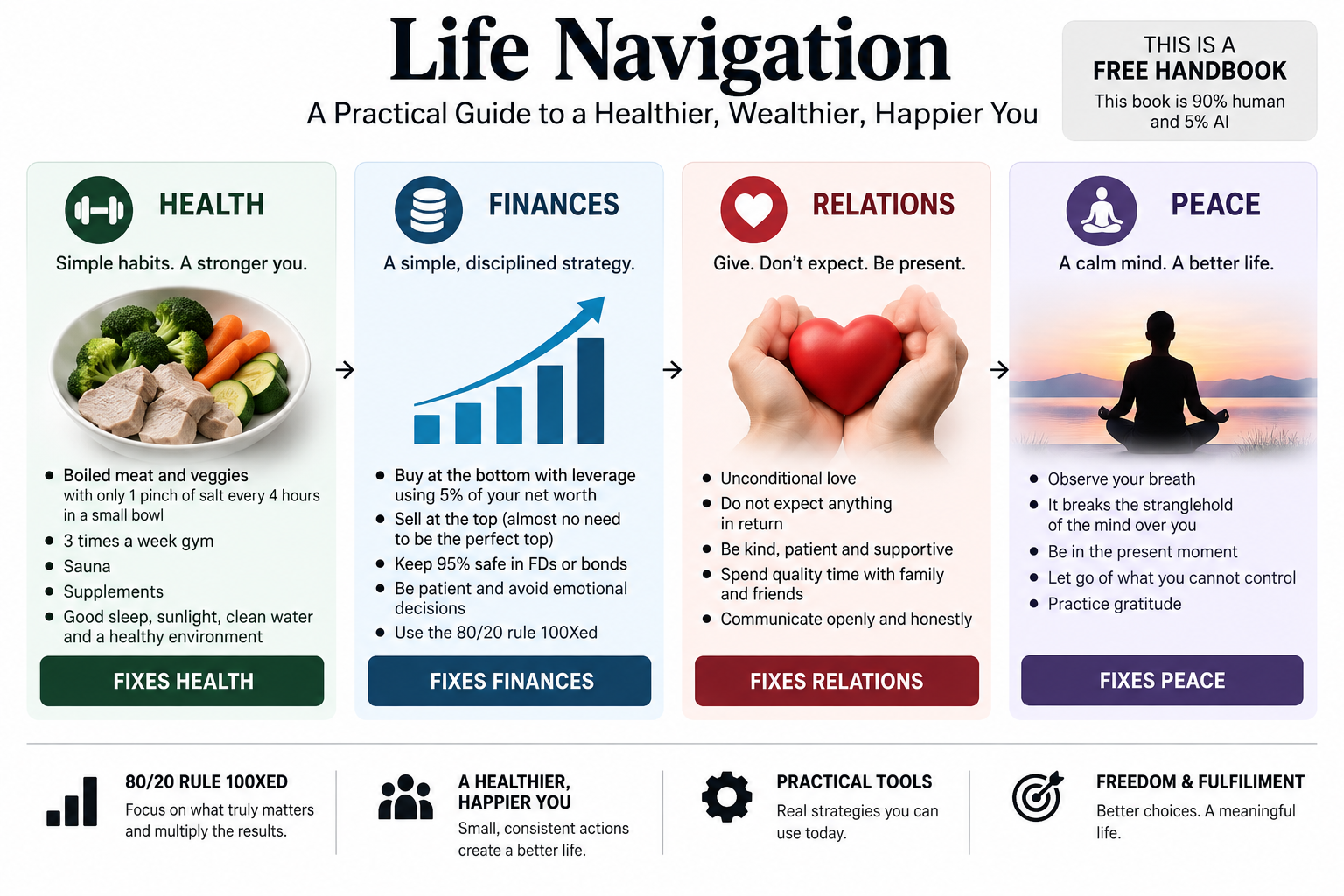
Start here. These are the big ideas that the handbook explores in much greater detail. Use them as prompts for action and research—not as promises or substitutes for professional advice.
For gout, the book's practical message is simple: STOP HAVING SUGAR and consider lemon juice as a dietary habit. Gout needs proper medical assessment and treatment; this is not a guaranteed cure.
Some stevia products are blended with erythritol. CHECK THE PACKAGING. If a product lists erythritol, it is not the same as pure stevia leaf. Do not assume every stevia powder has the same ingredients.
Give your children age-appropriate Auto-Suggestion and encourage repeated reading. One suggested practice in this book is to read each important chapter many times—up to 20 readings—to reinforce the ideas and study habits.
Learn what chlorine and fluoride are, what the evidence says, and where the book's spiritual ideas about the “third eye” fit into its broader framework. Separate belief, hypothesis and established evidence.
The book's risk framework is to keep the large majority of wealth protected—around 90% in FDs or bonds—and keep higher-risk leveraged activity to a small portion, around 5–10%, only if you fully understand the risk.
Build simple daily actions: read for 15 minutes, walk regularly, and make movement a non-negotiable part of your routine. Consistency matters more than intensity you cannot sustain.
When you pray, you talk to God; when you meditate, you become quiet enough to listen. Observe the breath, settle the mind and create space for reflection.
Use Auto-Suggestion, reminders, automation, sales systems and repeatable processes. The goal is to create systems that keep working even when you are not constantly present.
Study historical patterns, incentives, economic cycles, human behaviour and life cycles. You cannot literally predict the future with certainty, but you can improve your ability to anticipate scenarios and prepare for them.
Learn to be happy with yourself, give without keeping score, communicate with empathy, read every Sunday, add reminders to your iPhone, and then DO what you have learned.
Health. Wealth. Relationships. Self-discipline. Happiness. The objective is not to know more; it is to do more of what matters.
You may live with your mind for approximately 70 years or more. It is wise to train it so that it does not unnecessarily disturb you or create avoidable suffering and pain. We have all been blessed with a mind and a body, but nobody has taught us how to use them. Let this e-book act as an auto-suggestion and training manual: repeatedly feed your mind useful ideas, question unhelpful patterns, and practice turning those ideas into wise action.
Build the body. Strengthen the mind. Deepen the spirit. Master your money. Become the person who can carry the life you want.
Build muscle and become physically powerful, energetic, confident, and capable—in your body, in your relationships, in your bedroom, and in the world outside it. Learn the discipline of training, recovery, nutrition, confidence, communication, and self-respect. In investing, learn to avoid emotional extremes: do not buy at euphoric tops or sell in panicked bottoms; build a process for valuation, risk, patience, and disciplined entries and exits.
Align yourself with God—or, for those who use different language, with the highest truth and purpose you recognize. Where focus goes, energy flows. What you repeatedly attend to becomes increasingly important in your inner world. The interpretation of an event can profoundly shape the experience of the event. Change the way you look at things, and your choices, responses, and possibilities can change with it.
Many recurring problems become easier to understand when you ask the deepest question: Who am I? Meditation is one way to investigate that question rather than merely reacting from habit, fear, ego, or desire. The goal is not to abandon the physical world for the spiritual world, but to develop both: win in the spiritual realm and in the physical realm.
Do not make your identity dependent on the need to win. Become the kind of person who is a winner before the scoreboard confirms it: disciplined, strong, truthful, calm, capable, generous, courageous, and consistent. Then pursue wealth, health, love, strength, and purpose from that identity—not from desperation. You are not trying to become a different body; you are transforming the person living inside this body.
Use this section as a daily auto-suggestion: read it, visualize it, embody it.
Get your hormones like testosterone, HGH, etc. checked in your blood test. If they are low or on the lower side of the range, eliminate carbs and consume healthy proteins. Do your own research on how many grams of meat or vegetable protein you need to eat to fulfil your protein requirement — for example, 120 grams of protein is in 500 grams of mutton... NOT 2 PIECES OF CHICKEN BREAST!
Start with diagnosis, not a dose. Testosterone treatment should be considered only after appropriate medical evaluation, symptoms/signs of testosterone deficiency, and consistently low laboratory measurements. The Endocrine Society recommends accurate testing and a proper diagnostic work-up before treatment.
Exogenous testosterone can suppress the body's own hypothalamic-pituitary-testicular signalling. It can therefore reduce endogenous testosterone production and sperm production. This is one reason testosterone therapy should be prescribed and monitored by a qualified clinician rather than self-administered at high doses.
Normal testosterone production varies between men and across time; a commonly cited physiological average is about 5–7 mg per day. A testosterone gel dose cannot be compared directly with endogenous production because absorption varies by formulation and person. Therefore, do not assume that a particular gel dose is automatically safe or appropriate for you.
For further education, watch Andrew Huberman's discussions with Dr. Kyle Gillett on male hormone optimization. They cover blood testing, testosterone therapy, fertility, sleep/lifestyle, clomiphene and other hormone-related topics. The episode itself states that this is general educational information, not medical care.
▶ Watch: Tools for Hormone Optimization in Males — Dr. Kyle Gillett / Andrew Huberman
Clomiphene is a selective estrogen-receptor modulator that can increase endogenous testosterone in some men by altering feedback to the hypothalamus and pituitary. The AUA guideline discusses SERMs such as clomiphene as an option in selected situations, particularly where preserving sperm production matters. It should be used only under appropriate medical supervision.
Anastrozole is an aromatase inhibitor. It reduces conversion of testosterone to estradiol and may be used in selected clinical situations when estradiol is elevated. It is not a general-purpose method for simply making free testosterone “high” and bound testosterone “low,” and inappropriate suppression of estradiol can also cause problems. This is a clinician-guided laboratory and symptom question, not a DIY protocol.
Sleep, exercise, body composition, nutrition and stress management all belong in the hormone-health conversation. Check appropriate blood markers with a qualified clinician and interpret total testosterone, free testosterone, SHBG and other relevant results together rather than chasing one number.
No one on earth has told you that hormones are made up of amino acids — and no one has told you that you need hormones to get the feel-good factor while in the gym or doing any hard work, mental or physical. More energy is with people who have enough veggies, get the required potassium, and have hormones on the higher side of the range. It's not advisable to use unnatural ways to increase hormones — instead, eat quality protein and make sure you get 120–150 grams of protein every day by having a little meat or vegetable protein in every meal along with veggies.
Avoid salt and sugar.
Why this paragraph here? Because diseases — heart attacks, diabetes, thyroid, etc. — are like paper tigers which have no power unless we feed them sugar, salt, less protein (hence less hormones), and no energy to work out.
Cholesterol is also needed to build hormones, which is found in meat — HDL, not LDL (which the liver makes when there is excess glucose in the bloodstream).
Excess Fructose = Triglycerides. Excess Glucose = LDL. No two ways about it — it's the function of the liver.
Your body needs cholesterol and triglycerides, not sugar! Because we don't eat healthy fats, the liver converts glucose or fructose into fat. Remember to avoid sugar alcohols. Remember: fasting won't raise HGH if there isn't enough protein in the diet! Remember: insulin — a fat-storing hormone — is released when we eat glucose, and glucagon — a fat-burning hormone — is released when we eat healthy fats.
For more research, watch Dr. Rhonda Patrick and Andrew Huberman.
Note: This is not medical advice. There are no doctors on the Longevity team. Do your own research. Consult with a doctor before acting upon any health advice.
These are educational starting points, not treatment plans. The safest approach is to use the information to ask better questions and work with an appropriate clinician.
STOP HAVING SUGAR. This is the clear language used in the Life Navigation practical framework. Lemon juice may be used as a simple dietary habit, while proper diagnosis and medical treatment remain important.
STOP HAVING SUGAR. High blood pressure should be measured accurately and managed according to its severity and your overall cardiovascular risk. Lifestyle changes are important, but supplements should not replace proven treatment.
If you have known heart disease, your treatment depends on the specific diagnosis. EECP (enhanced external counterpulsation) is a supervised medical therapy that may be considered for selected patients with refractory angina; it is not a general treatment for every heart patient.
Life Navigation is a free handbook. No payment or registration is required to read it. You can read the complete material here, listen to the free audio resources, and explore the optional tools below.
A generic, child-friendly reading routine for children approximately 5–10 years old. Download it and share it with your kids.
Download the Kids Auto-Suggestion PDFAuto-Suggestion is a personal script, not a fixed formula. Choose a version below, copy it into Notes, add or remove lines, record yourself reading it, and listen while walking, cooking or driving. Read it every day and put the related actions into your iPhone Reminders.
Practice: Edit anything that does not fit you. Then make your own recording and listen repeatedly.
Practice: Edit anything that does not fit you. Then make your own recording and listen repeatedly.
Practice: Edit anything that does not fit you. Then make your own recording and listen repeatedly.
Practice: Edit anything that does not fit you. Then make your own recording and listen repeatedly.
Practice: Edit anything that does not fit you. Then make your own recording and listen repeatedly.
Practice: Edit anything that does not fit you. Then make your own recording and listen repeatedly.
Practice: Edit anything that does not fit you. Then make your own recording and listen repeatedly.
Practice: Edit anything that does not fit you. Then make your own recording and listen repeatedly.
Practice: Edit anything that does not fit you. Then make your own recording and listen repeatedly.
Practice: Edit anything that does not fit you. Then make your own recording and listen repeatedly.
Use these free audio resources while reading Life Navigation.
We do not know where you are in your journey, but weight loss can become much simpler when your food and movement are consistent.
Find the exercises that do not leave you so sore that you cannot return the next day. The goal is a routine you can repeat for months, not a heroic workout you abandon after a week.
Source note: The following is the original health material supplied for this project. It is preserved as source material and should be read together with the site’s health disclaimer. These claims are not presented here as verified medical facts.
LONGEVITY HEALTH TIPS
These are not advise of doctors, you are responsible for any changes to your health if you implement these strategies! We won't take the credit!
These are not advise of doctors, you are responsible for any changes to your health if you implement these strategies! We wont take the credit! This is a rough write up — if we get enough responses via email — of people like you appreciating all this knowledge, we will get this proof written and will work on really making it great. This is a trial because we don't know how many people will actually read so much logic at one go! Because logic doesn't sell easily, emotions sell easily and here there is only pure logic. Only Visualization, HARD-WORK won't help maybe You need STRATEGIES to take MASSIVE ACTION. Dehypnotize yourself! If you have been taking carbs at any point of your life for around 5-6 years all this is helpful for you because the carbs deplete your minerals like zinc, potassium, magnesium, etc. Helping you model the best. Tools you can use starting tomorrow. How to 10x your output? How to use dispassion in your favor to correct your own mistakes? >> It's deep knowledge compressed into actionable pieces. >> It's all the top tools you can use right now. Also — Let's find out our unconscious patterns which are harming us directly and indirectly. There are 100+ things you need to know and act on over a sustained period of time in order to get a rich life. Let's be EVEN more conscious! (You and I are both going to be here 20 years later.) Actionable info for HUSTLERS with self-awareness. Do you feel every major problem has: 1 major cause? Example obesity = sugar. Because the mind has a clever way of fooling us by showing that there are many factors to consider to solve 1 problem (sometimes a problem has only 1 reason). Only for people who work hard and don't want to suffer and enjoy more IN THE LONG TERM. Why is it that people fall sick even after knowing all the things they see and hear about in videos etc? The answer could be: They do not get proper nutrition and are stuffing their cells with toxins like yeast, mold, fungus, aluminum, mercury, etc. It's human nature to go for the fun thing now and then face the consequences later on in life — basically suffer! And then there is misinformation like tomato seeds cause kidney stones!!! :) People think roti and fruits are good!! Please surrender 100% and become a learning machine by knowing that you don't know it all and there is always room for improvement and become humble and be flexible. We know that you would not like to agree to the following but what if all of them are true in reality? Meaning could it be that what you were thinking all time is wrong and the following mentioned points are right! In health, 90% things are black and white since we all have 1 liver, 1 heart and the same body and in some things we are different like body types, etc. Acceptance is the biggest gift you can give to yourself right now as you start reading these points.
1.
Sleep is the biggest free asset you can tap into for detox and reducing inflammation because when we are awake we think too much and we don't leave enough energy for our body to use for cleaning etc. Whatever happens sleep for 9 hours at least every day because you cannot do anything to change anything if your sleep is messed up because the next day you won't be able to fight challenges as hard because you will lack clarity of thinking. Anyways when the sun explodes after around 4000 years all our acts will be irrelevant — so just relax. So don't let massive action and strategizing for the next 10 years of your life come in the middle of your sleep!
2.
Sleep on the earthing pad because antioxidants donate one free electron in them to free radicals which are positively charged; when you are grounded you get free electrons from mother earth. Reduce inflammation — get loaded with antioxidants or buy blueberries and other berries for antioxidants. Even some wellness advocates promote earthing; this is not presented as established medical evidence.
3.
Sleep naked because your skin breathes — it's the largest organ of your body and helps remove toxins via sweat — we can't be naked at work and in the house in the day — so, the least we can do is sleep naked.
4.
Use a tent mosquito net while sleeping naked on the earthing pad because you don't want any insects biting you! (if your house is not mosquito and dust proof).
5.
While sleeping naked on the earthing pad in the mosquito tent :) do not use a pillow instead use your hand as a pillow because when we use pillows it's unnatural for our spine and necks — 99% neck and back pains are because of pillows because the alignment between the neck and backbone is off.
6.
While sleeping naked on the earthing pad, place the earthing pad below your hand which you are using as a pillow because it's better to avoid the synthetic materials like polyester, viscose, etc near your head for 8+ hours! Also do not use a bed because our ancestors slept on the floor — use a foam based mattress without any springs because the springs act as EMF savers.
7.
Just before sleeping start meditating — meaning just observe your breath because this will deactivate your mind for better sound sleep.
8.
If you cannot turn off your mind drink ACV with little honey before sleeping. Also, take a good chemical free green tea like chamomile tea. Or if you have a sauna at home take a sauna and then take ACV and honey and green tea before you sleep.
9.
If you still can't turn off your monkey mind which is in the past or future — sit up and start taking deep breaths because this gives oxygen to the prefrontal cortex and makes the reptilian brain shut down.
10.
Once in a month sleep inverted meaning keep your legs elevated by placing them on a wall beside your bed because better blood flow to the brain means better sleep, better cleaning of the brain — that's why bats sleep inverted.
11.
Keep 1-2 pillows underneath your mattress so that your legs are a bit elevated — increasing blood flow to the brain.
12.
While sleeping your head must be in the east and feet towards the west because the earth has its electromagnetic field and in ancient teachings it's mentioned to keep head towards east.
13.
After taking a far infrared sauna have ACV and honey (add coconut water) then after 30 minutes have chamomile tea and start meditating — observe your breath as you lie down naked using your hand as a pillow on the earthing pad in a mosquito net tent on a foam mattress with 2-3 pillows placed below so blood flows towards your brain with your head towards the east!
Prefer listening? If you are a less active reader, you can play the audiobook in the background and listen while driving, cooking, walking, or doing other everyday activities. There are no visuals in the audiobook video—it is audio-only. If you are an avid reader, please keep reading the handbook and use the audio as an optional companion.
If you are a lighter reader, play the audiobook in the background while driving, cooking, walking or doing other everyday activities. The audiobook video is audio-only; there are no visuals. If you enjoy reading, keep reading the handbook as well.
Listen to the health audiobook while you read or while you are driving, cooking, walking, or doing other everyday activities.
Play the instrumental soundtrack quietly in the background while continuing to read.
14.
If you do eat breakfast — eat a protein-rich breakfast to gain muscle and lose fat because not much insulin is released when you eat protein compared to carbs.
15.
People think that enzymes are the fountain of youth because they improve digestion but most people don't know that if they lack minerals like zinc, manganese, copper etc these enzymes cannot function. So get your minerals checked and optimize them by supplementation or by superfoods.
16.
Why exactly sugar is the culprit: Sugar means 1 fructose and 1 glucose. Glucose if taken in limited quantities is not harmful but fructose is deadly because fructose creates triglycerides which means fat in the blood. Alcohol and fructose are similar compounds and both after entering the liver create triglycerides. High triglycerides equal high BP, heart attacks, and strokes.
24.
Cholesterol is needed by every cell in your body for creating hormones like VitD and testosterone. Best source according to Ayurveda is ghee. Other best source is eggs by grass-fed chickens. There are essential fats and proteins — there are no essential carbs.
25.
Acid-alkaline balance: ACV and lemon are alkaline, coffee is highly acidic along with sugar. Green juices help in alkalizing your body. ACV helps in acid creation in the stomach. Avoid alkaline water machines.
39.
Salts: Use Himalayan salt for cooking (81 minerals) and sea salt to add on food. Add a pinch of sea salt to water for super-hydration. Use black salt in green juices.
40.
Chew every bite 32 times because when we chew, food gets digested better and when you chew green leaves, your nitrate reserves are replenished — great for heart health.
49.
Put a copper wire in your water purifier because most of us are deficient in copper — it's useful for activating enzymes, the fountain of youth.
52.
Apart from activated charcoal, edible clay, and isabgol — superfoods are essential daily.
53.
Desi chicken eggs are better than normal eggs. Eggs are a brilliant source of Vit D3, K2, B12, Omega 3's — but the chickens must eat green grasses and different leaves.
17.
When excess glucose enters, the liver has to make bad cholesterol from it! So if anyone wants to lower LDL she/he must stop carbs for a while and the LDL will drop. When fructose or alcohol enters, the liver has to make triglycerides. The cure for diabetes and thyroid is liver empowerment by lowering bad estrogens by eating cooked beetroots and beet juice. The liver has around 500 functions.
18.
How to reverse fatty liver: Start consuming coconut oil, ghee, grass-fed butter. Start with 50 grams and after 20 days 100 grams and then after 15 days 200 grams. Have fats alone with salads and veggies — not with carbs. When you eat fats your pancreas releases glucagon which is a fat burning hormone unlike insulin which is a fat storing hormone.
57.
Your liver needs fats to regenerate so eat enough healthy fats especially coconut oil.
19.
Bipolar: The cure for bipolar is stopping all carbs and getting on a high-fat diet with supplements: L-tyrosine, 5-HTP, Niacin, Goji Berries (lithium), Lithium orotate, Vitamin K2, D3, B12, GABA, Krill Oil, Melatonin, Chaga Mushroom, Chocolate with stevia. The brain is around 60% omega 3 fats — give the body what it needs and it heals itself.
20.
Medicines are for people who are dependent on them. Meditation helps in making people know how irrelevant they are in the whole scheme of things. Medicines are great in emergency situations. The body is more intelligent than the conscious mind — massive action is the cure-all.
21.
Mold: If there is mold in your house — it's very bad because mold enters via your nostrils into your brain. Eliminate mold by using charcoal on rooftops and walls and ensuring no water leakage. Watch the documentary MOLDY for more info.
22.
Activated charcoal is negatively charged which binds to all positively charged particles in your intestines and brings them out via stool. Activated charcoal cannot be absorbed by the intestines.
33.
Garlic is a dangerous compound because it has sulfur-containing particles which enter the blood-brain barrier and kill brain cells. After quitting garlic you might see: clarity of mind, no lethargic afternoons, no body odor.
34.
Get rid of all plastic containers from your kitchen because it's made of petroleum and all foods breathe.
35.
Aluminum vessels: When you cook in aluminum vessels you ingest aluminum — get rid of them.
36.
Use ceramic knives because steel knives leave steel particles on vegetables.
37.
No fluorine toothpaste: Fluorine blocks your pineal gland, blocking intuition and clarity of mind.
38.
Educational material only. Heating edible oils at very high temperatures or for prolonged periods can change their chemical composition.
Chlorine in water kills healthy bacteria on your scalp leading to hair fall — use a shower de-chlorinator.
44.
CFL: The mercury in CFL and LED lights is detrimental for the brain. Use good old neon bulbs.
23.
Testosterone replacement medicines: When you eat testosterone for long durations your body stops manufacturing it. Use pine pollen (bioavailable testosterone), shilajit, maca root. Testosterone gives a feeling of well-being and decreases anger.
26.
Have spring water in glass bottles because it is the purest form of water untouched by humans since 9000 odd years.
27.
As soon as you get up drink 1 bottle of water because you were sleeping for around 9 hours and did not drink water.
28.
After freshening up drink 1 bottle of water with 2 lemons' juice squeezed in because vitamin C enters the cells in the absence of glucose only — highly recommended for heart patients.
29.
On every Sunday — drink only when you are thirsty. This gives time to your kidneys to cleanse and do other important functions.
30.
Water fast — once a month, make it the 1st of every month. Do not drink water at all just to realize the importance of water.
31.
Add 1 pinch of sea salt in all glass bottles of water because this salt will make the water enter your cells easily because of the conductivity of the salt.
32.
Place stickers with love, grace, wisdom, empathy written on your glass bottles because water has memory and it gets positively charged.
41.
Feedback mechanism: If you drink lots of water your body will excrete more. If you eat enough healthy fats your body will let go of stored fat. It doesn't work for all things but works for some.
43.
Sitting is the new smoking. Put a reminder every 20 minutes: 'Get up and walk, jump, do 5 squats.' We were designed to hunt and gather and be in the open.
54.
No screen day: Once a week have a no screen day — let your eyes relax and be natural!
55.
Sungazing: Appreciate the sun and be grateful to it because it's powering every creature.
58.
Get up early, sleep at 9, don't eat after 5 PM because metabolism gets slower as the sun sets.
59.
The lymphatic system is bigger than the circulatory system and has no pump. Detox it by body massages, acupressure, jumping on a trampoline, walking and running.
61.
Trampoline is used to move the lymphatic system — the bigger the trampoline the better because the higher you jump the better it is.
62.
Oil pulling: Swish organic virgin coconut oil in your mouth for 2-3 minutes then spit it out — this sucks toxins out of your mouth and esophagus.
63.
A body massage every 3-4 days is an asset for blood circulation and moving the lymph nodes. Get acupressure done before the massage and then enter the sauna.
64.
Always use Indian toilet style because the rectum opens up for the stool to pass — it's not natural for humans to sit on western toilets. Sitting on western toilets with legs open causes varicose veins.
42.
Walking and exercising does not help in reducing fat and diseases: Cardio burns fat only during the activity. Sprints and intense exercise burn glucose during activity and fat for the rest of 23 hours. Eat 200g healthy fats (ghee, coconut oil, Kerrygold butter) without carbs and you will lose body fat.
60.
Treadmill desk — Install it in your office and keep walking at speed 0.5-1 while working.
45.
Aluminum sheets on walls of your bedroom stop cell phone and WiFi radiations from hitting your body while you sleep.
46.
While walking long distances use aluminum foil wrapped around your phone to reduce EMFs near your body. Be very careful — don't heat up your phone.
47.
Use EMF filters in your home and office and on your phone to stop dirty electricity.
48.
Shut down the main power supply of your home while sleeping because electric wires near your head for 9 hours disturb brain frequencies.
50.
Have isabgol one spoon every day for better bowel movements.
51.
Consume 1 tablespoon of sauerkraut (fermented foods) every day because these are rich in probiotics. We are around 90% bacteria and 10% human cells.
56.
No eating/drinking in planes because the food is not fresh and water is in plastic bottles. When you land, sun gaze for 15 minutes to realign your circadian rhythms.
65.
Avoid sugar alcohols like Maltitol, Erythritol, etc and use FOS. Some people get upset stomach by using FOS in cooked items like pancakes — be cautious.
If you found this valuable, let us know via email and we'll make it even better.
This handbook is designed to keep evolving. Learn from different sources, question claims, and discuss health decisions with qualified professionals before acting.
Watch this video as part of your ongoing health education. Take notes, compare ideas with reliable evidence, and keep learning rather than treating any single video as the final word.
Do not heat olive oil without understanding what happens to the oil. Olive oil can be used raw in salads and other foods. The video below discusses heating olive oil; compare its claims with reliable evidence before changing your diet.
↑ Watch the video, take notes, and research the topic before making dietary changes.
Keep exploring. You can learn from long-form conversations and educational content featuring Joe Rogan, Andrew Huberman and Rhonda Patrick, while checking claims against high-quality evidence. Wealth, happiness and health are a journey — keep learning, keep questioning, and keep improving.
A dedicated Joe Rogan video section has been restored so the video is visible directly on the website. This episode features Dr. Rhonda Patrick discussing health and heat/sauna research.
Educational resource only. Claims discussed in the video should be checked against current evidence and discussed with qualified professionals before making health decisions.
Everything is now on this page. Open a section with the arrow when you want the detail; close it when you want the bigger picture. The goal is not to overwhelm you with information but to make the right information available when you need it.

If Life Navigation is useful to you, you can support the project with an optional donation.
Listen to the Free Health Audiobook →Play the Instrumental Soundtrack →A practical framework for creating useful videos, editing them clearly, and improving the chance that people discover and share them.
Start with one clear audience problem or question. Pick topics people already care about, then add a useful angle, story, demonstration or result.
Open quickly. Tell viewers what they will learn or why the video matters. Avoid long introductions before delivering value.
Use clear audio, good lighting, stable framing and a simple background. Speak naturally and remove distractions.
Cut pauses, repetition and unnecessary sections. Keep the pace moving, use relevant B-roll or on-screen text, and make every edit serve the viewer.
Make the promise clear and accurate. The title and thumbnail should create curiosity without misleading the viewer.
Explain what the video contains, add useful links, and use chapters when they improve navigation.
Study click-through rate, watch time, audience retention and comments. Use the data to improve the next video rather than chasing one viral result.
Give viewers a simple reason to share: solve a real problem, teach something useful, tell a compelling story, or provide a resource worth passing on.
Turn successful topics into related videos and playlists. A consistent series can help viewers understand what to expect from your channel.
There is no guaranteed formula for virality. Improve the topic, packaging, first minute, viewer value and consistency through repeated testing.
The following source points were previously supplied for Life Navigation. They are included here without numbering; where a claim is not established medical fact, that limitation is stated.
Sleep is presented as a major free asset for recovery, reducing inflammation and supporting the body’s normal restorative processes. The source recommends about 9 hours of sleep and emphasizes not allowing long-term planning or intense effort to interfere with sleep.
The source recommends sleeping on an earthing/grounding pad, based on the idea that grounding supplies free electrons and may reduce inflammation. Evidence for broad health benefits of grounding remains limited and mixed.
The source recommends sleeping naked, reasoning that the skin is the body’s largest organ and that sweating contributes to toxin removal. This is a personal-preference claim, not an established requirement for health.
The source recommends using a mosquito net/tent when sleeping naked on an earthing pad if the home is not adequately protected from mosquitoes and dust.
The source recommends avoiding a pillow and using the hand as a pillow, claiming that pillows are unnatural for spinal and neck alignment. The claim that pillows cause 99% of neck and back pain is not established evidence.
The source recommends placing the earthing pad under the hand used as a pillow, avoiding synthetic materials near the head, sleeping on a foam mattress without springs, and sleeping on the floor rather than a conventional bed because of ancestral practice and a claimed EMF concern. These claims are not established medical requirements.
The source recommends meditating immediately before sleep by observing the breath, with the aim of quieting mental activity and improving sleep.
If the mind remains active, the source suggests ACV with a little honey before sleep and chamomile or another suitable green/herbal tea. It also suggests a sauna followed by ACV, honey and tea. These are optional wellness practices, not established treatments for insomnia.
If the mind remains active in the past or future, the source suggests sitting up and taking deep breaths, claiming this increases oxygen to the prefrontal cortex and quiets the “reptilian brain.” Deep breathing can be a relaxation practice, but the specific brain mechanism stated is not established.
The source recommends once a month sleeping with the legs elevated against a wall, claiming that improved blood flow to the brain can improve sleep and brain cleaning. The comparison with bats is an analogy, not evidence.
The source recommends placing 1–2 pillows under the mattress so the legs are slightly elevated, again with the stated aim of increasing blood flow to the brain.
The source recommends sleeping with the head toward the east and feet toward the west because of the Earth’s electromagnetic field and ancient teachings. This should be treated as a traditional/spiritual practice rather than an established medical requirement.
The source combines its sleep practices into one routine: after a far-infrared sauna, have ACV and honey with coconut water; after about 30 minutes, have chamomile tea and meditate by observing the breath; then sleep naked, using the hand as a pillow, on an earthing pad inside a mosquito net on a foam mattress, with 2–3 pillows under the mattress and the head toward the east. These combined practices are source recommendations, not medical prescriptions.
If breakfast is eaten, the source recommends a protein-rich breakfast to support muscle gain and fat loss, claiming that protein produces less insulin release than carbohydrates. Protein can support satiety and muscle, but insulin responses are more nuanced than this simplified comparison.
The source argues that enzymes depend on minerals such as zinc, manganese and copper and recommends checking mineral status and optimizing deficiencies through appropriate supplementation or nutrient-dense foods.
The source identifies sugar as a major problem, distinguishing glucose from fructose and claiming that fructose is “deadly” because it produces triglycerides in the liver. It compares fructose and alcohol and links high triglycerides with high blood pressure, heart attacks and strokes. Excess added sugar and high triglycerides can be health concerns, but the source’s absolute wording should not be treated as a complete causal model.
The source states that cholesterol is needed by every cell and for hormones including vitamin D and testosterone; it recommends ghee as a preferred source according to Ayurveda and grass-fed chicken eggs as another source. It also states that there are essential fats and proteins but no essential carbohydrates. This combines nutritional facts with traditional dietary framing.
The source recommends an acid–alkaline approach in which ACV and lemon are described as alkaline, coffee and sugar as highly acidic, and green juices as alkalizing. It also says ACV supports acid creation in the stomach and advises against alkaline-water machines. These acid–alkaline claims require careful interpretation because the body tightly regulates blood pH.
The source recommends Himalayan salt for cooking, sea salt on food, a pinch of sea salt in water for “super-hydration,” and black salt in green juices. Salt intake should remain appropriate to individual blood-pressure and medical needs.
The source recommends chewing every bite 32 times for better digestion and claims that chewing green leaves replenishes nitrate reserves for heart health. Thorough chewing can support eating pace and digestion, but the exact 32-chew rule is not a universal medical requirement.
The source recommends putting a copper wire in a water purifier because it claims many people are copper deficient and that copper activates enzymes. Do not add copper to drinking water without appropriate safety and water-quality considerations.
The source recommends activated charcoal, edible clay and isabgol in addition to daily superfoods. These are not interchangeable, and activated charcoal or edible clay should not be treated as routine detox products without understanding safety and interactions.
The source states that desi chicken eggs are better than ordinary eggs and recommends eggs from chickens that eat green grass and varied leaves, claiming they can provide vitamin D3, K2, B12 and omega-3 fats. Nutrient composition varies with feed and production.
The source claims that excess glucose entering the liver is converted into “bad cholesterol” and recommends stopping carbohydrates for a period to lower LDL. It also states that fructose or alcohol entering the liver produces triglycerides and describes liver empowerment through cooked beetroots and beet juice as a cure for diabetes and thyroid disease. The cure claim is not established medical evidence.
The source recommends coconut oil, ghee and grass-fed butter for reversing fatty liver, starting at 50 g and increasing to 100 g and then 200 g, eating fats with salads and vegetables rather than carbohydrates, and attributes fat burning to glucagon. This high-fat protocol is not a general treatment recommendation for fatty liver and should not replace medical care.
The source states that the liver needs fats to regenerate and recommends adequate healthy fats, especially coconut oil. Overall dietary pattern and individual medical context matter.
The source claims that bipolar disorder can be cured by stopping carbohydrates, adopting a high-fat diet and using a large supplement list including L-tyrosine, 5-HTP, niacin, goji berries/lithium, lithium orotate, vitamin K2, D3, B12, GABA, krill oil, melatonin, chaga mushroom and stevia-sweetened chocolate. It also claims the brain is about 60% omega-3 fats and that supplying nutrients allows the body to heal itself. These are not established treatments for bipolar disorder; prescribed psychiatric care should not be stopped or replaced on this basis.
The source says medicines are for people who are dependent on them, describes meditation as a way to recognize their perceived irrelevance, says medicines are useful in emergencies, and states that the body is more intelligent than the conscious mind and that massive action is a cure-all. These statements are philosophical/source framing, not a basis for stopping prescribed medicines.
The source warns that household mold is harmful and claims mold can enter the brain through the nostrils. It recommends eliminating mold, using charcoal on rooftops and walls and fixing water leaks, and refers readers to the documentary “MOLDY.” The practical priority is moisture control and professional remediation where appropriate; the specific brain claim requires evidence.
The source says activated charcoal is negatively charged, binds positively charged particles in the intestines and removes them in stool, and cannot be absorbed by the intestines. Activated charcoal has specific medical uses and can interfere with medicines; routine “detox” use is not automatically appropriate.
The source describes garlic as dangerous because sulfur-containing compounds allegedly cross the blood-brain barrier and kill brain cells, and says stopping garlic may improve mental clarity, afternoon energy and body odor. These claims are not established and conflict with the broader evidence base on garlic as a food.
The source recommends removing plastic containers from the kitchen because they are petroleum-based and says foods “breathe.” Reducing unnecessary plastic exposure can be reasonable, but the stated mechanism is not established.
The source recommends eliminating aluminum cooking vessels because cooking in them is said to cause aluminum ingestion. Exposure depends on cookware, food, acidity and cooking conditions; an absolute prohibition is not established.
The source recommends ceramic knives because it claims steel knives leave steel particles on vegetables. This is not an established health requirement.
The source recommends fluoride-free toothpaste because it claims fluorine blocks the pineal gland and intuition/clarity. The pineal-gland/intuition claim is not established medical fact, and fluoride has well-established dental uses at appropriate concentrations.
The source states that chlorine in water kills healthy bacteria on the scalp and causes hair loss and recommends a shower de-chlorinator. Chlorinated water is generally used for microbial safety; shower filtration is an optional preference and broad hair-loss claims need evidence.
The source claims mercury in CFL and LED lights is detrimental to the brain and recommends old-style neon bulbs. CFLs contain small amounts of mercury, while LEDs generally do not; safe handling and disposal matter, but the stated brain-harm claim is not established.
The source warns that long-term testosterone replacement can suppress the body’s own testosterone production and recommends pine pollen, shilajit and maca root as alternatives, describing testosterone as supporting well-being and reducing anger. Testosterone therapy requires medical evaluation; supplements are not established substitutes for indicated hormone treatment.
The source recommends spring water in glass bottles, describing it as the purest form of water and saying it has remained untouched by humans for thousands of years. Water safety depends on source protection and testing, not age alone.
The source recommends drinking one bottle of water immediately after waking because of the overnight period without fluids.
The source recommends drinking a bottle of water with the juice of two lemons after freshening up and claims vitamin C enters cells in the absence of glucose and strongly recommends this for heart patients. Lemon water can be a convenient source of flavor and some vitamin C, but it is not a heart treatment.
The source recommends drinking only when thirsty every Sunday to give the kidneys time to cleanse. Healthy hydration generally depends on thirst, conditions, activity and medical circumstances; deliberately restricting fluids is not a universal kidney-cleaning practice.
The source recommends a monthly water fast in which no water is consumed, specifically to appreciate the importance of water. Deliberate water deprivation can be dangerous and should not be treated as a wellness practice.
The source recommends adding a pinch of sea salt to every bottle of water, claiming that conductivity makes water enter cells more easily. Salt does not make hydration universally better, and excess sodium can be harmful for some people.
The source recommends placing stickers with words such as love, grace, wisdom and empathy on glass water bottles because it claims water has memory and becomes positively charged. This is a spiritual/experimental belief, not established scientific fact.
The source describes a feedback mechanism in which drinking more water leads to more excretion and eating enough healthy fats leads the body to release stored fat, while acknowledging that this does not apply to everything. These are simplified physiological descriptions.
The source recommends a reminder every 20 minutes to stand up, walk, jump or do five squats, emphasizing that humans evolved to move rather than sit continuously. Breaking up prolonged sitting is a practical health strategy.
The source recommends one no-screen day per week to allow the eyes to relax and return to natural activity.
The source recommends sungazing as a way to appreciate and feel grateful for the sun. Directly staring at the sun can damage the eyes, so gratitude should not require looking directly into sunlight.
The source recommends waking early, sleeping at 9 p.m. and not eating after 5 p.m., claiming metabolism slows as the sun sets. Consistent sleep and meal timing can be useful, but these exact times are not universal requirements.
The source states that the lymphatic system is larger than the circulatory system and has no pump and recommends massage, acupressure, trampoline jumping, walking and running to “detox” it. Movement supports lymphatic flow, but the detox framing is simplified.
The source recommends a trampoline for lymphatic movement and claims that a larger trampoline and higher jumps are better. Exercise should be scaled to fitness, balance, age and injury risk.
The source recommends oil pulling with organic virgin coconut oil for 2–3 minutes and claims that it removes toxins from the mouth and esophagus. Oil pulling may be a personal oral-hygiene practice, but toxin removal from the esophagus is not established.
The source recommends body massage every 3–4 days for circulation and lymph-node movement, preceded by acupressure and followed by a sauna. Massage can support relaxation and comfort; the stated detox mechanism is not established.
The source recommends Indian-style squatting toilets, claiming that Western toilets are unnatural and that sitting with the legs open causes varicose veins. Toilet posture can affect comfort and bowel mechanics, but the stated varicose-vein claim is not established.
The source claims ordinary walking and exercise do not help reduce fat or disease, says cardio burns fat only during activity, says sprints and intense exercise burn glucose during activity and fat for the remaining 23 hours, and recommends 200 g of healthy fats without carbohydrates for fat loss. Exercise is beneficial for health and body composition, but these absolute claims and the 200 g protocol are not established universal guidance.
The source recommends a treadmill desk in the office and walking at about 0.5–1 speed while working. The practical principle is to add light movement during sedentary work while maintaining safe concentration and posture.
The source recommends aluminum sheets on bedroom walls to block cell-phone and Wi-Fi radiation while sleeping. This is an EMF-shielding claim; any shielding product should be evaluated for measurable performance, safety and unintended effects.
The source recommends wrapping a phone in aluminum foil during long walks to reduce EMF exposure and warns not to heat the phone. Shielding can alter device behavior and signal strength; this should not be treated as a proven health intervention.
The source recommends EMF filters at home, in the office and on the phone to stop “dirty electricity.” Products should be evaluated for measurable performance and plausible mechanisms; labels alone do not establish health benefits.
The source recommends shutting off the home’s main power supply while sleeping because it claims nearby electrical wires disturb brain frequencies. This is not an established medical requirement, and electrical safety should be considered before changing household power systems.
The source recommends one spoon of isabgol/psyllium every day for better bowel movements. Psyllium is a well-established source of soluble fiber for bowel regularity when used with adequate fluid and appropriate precautions.
The source recommends one tablespoon of sauerkraut or other fermented foods every day because they contain probiotics and states that humans are approximately 90% bacteria and 10% human cells. Fermented foods can contribute beneficial microbes depending on the product, but the 90/10 human-cell claim is an oversimplification.
The source recommends not eating or drinking on airplanes because it considers airplane food and bottled water insufficiently fresh and recommends 15 minutes of sun exposure after landing to realign circadian rhythms. Travel nutrition and hydration should be individualized, and direct sun exposure should be safe rather than prolonged or unprotected.
The source recommends avoiding sugar alcohols such as maltitol and erythritol and using FOS instead, while warning that some people may develop stomach upset from FOS in cooked foods such as pancakes. Tolerance to sugar alcohols and FOS varies between individuals.
Check Vitamin D3 and B12 when appropriate; if a deficiency is confirmed or strongly suspected, discuss starting an appropriate supplement promptly rather than self-prescribing high doses.
Avoid unnecessary handling of thermal-paper receipts and wash your hands after handling them, especially before eating. Some thermal papers have used BPA or BPS as developers, and exposure can occur through skin contact; the exact composition varies by receipt and product. Do not treat every receipt as automatically “toxic,” but minimizing unnecessary contact is a reasonable precaution.
Fluoride in drinking water should be discussed using dental, public-health and individual-risk evidence; claims about the third eye are not established medical facts.
Separate traditional or spiritual interpretations from scientific claims when discussing the body and consciousness.
Use source labels: established evidence, emerging evidence, hypothesis, tradition or anecdote.
Check supplement quality because contamination and inaccurate labeling can turn a natural product into a risk.
Use third-party testing where available for algae, herbal products and concentrated supplements.
Food-first nutrition is usually a stronger foundation than building a large supplement stack.
Do not let wellness optimization crowd out sleep, exercise, relationships and preventive care.
All 10 book summaries are included directly in this website. Open or close each book with the arrow.
Some homes run smoothly because someone remembers the small things. Use this as a master list, then copy only what applies to your home into your iPhone Reminders.
10 curated books · full summaries + deeper guides. Each book opens and closes independently.
A practical reading guide: central ideas first, deeper material below.
View on Amazon →Affiliate disclosure: this book button uses the publisher-supplied recommendation link. Product availability, pricing and eligibility can change.
An original Life Navigation synthesis of the book’s central ideas, followed by a deeper chapter-by-chapter guide. Open the sections below as needed.
Think and Grow Rich presents success as a disciplined philosophy rather than a lucky event. Hill’s central argument is that achievement begins with a clearly defined desire and becomes more likely when that desire is converted into a definite plan, persistent action, organized knowledge, and cooperation with capable people. The book was built around Hill’s long study of successful people and became his best-known statement of his philosophy of success. The first major lesson is definiteness of purpose. A vague wish such as “I want to be successful” does not provide enough direction for behavior. Hill asks the reader to define what they want, what they are willing to give in return, the time frame, and the plan for getting there. Desire therefore becomes a commitment rather than a fantasy. Faith, in Hill’s framework, means cultivating confidence in the possibility of the goal and repeatedly reinforcing that commitment. This can be understood practically as building an internal expectation that encourages action rather than paralysis.
Hill then emphasizes specialized knowledge. General information is useful, but results usually come from knowing something relevant deeply enough to apply it. Knowledge becomes powerful when organized into a plan and connected to other people’s expertise. This leads to the Master Mind concept: deliberate cooperation among people with complementary knowledge, experience, judgment, and commitment. The practical modern interpretation is to build an advisory circle rather than trying to solve every difficult problem alone. Another major theme is persistence. Hill treats setbacks as part of the process rather than automatic evidence that the goal is impossible. Persistence is strengthened by a definite purpose, a plan, supportive relationships, and the ability to revise methods without abandoning the objective. The book also warns about indecision and fear. Fear of poverty, criticism, ill health, loss of love, old age, and death can become psychological barriers that cause people to avoid action. The book’s idea of autosuggestion can be interpreted as deliberate repetition of goals and beliefs so that attention remains oriented toward them. Modern readers should treat this as a motivational practice rather than as proof that thoughts mechanically create external events. Similarly, Hill’s imagination and subconscious-mind language is most useful when it encourages planning, creativity, and persistence, not when interpreted as a guarantee of wealth. The deepest practical lesson is that desire must be converted into organized behavior. Define the target. Acquire relevant knowledge. Create a plan. Build relationships with capable people. Act consistently. Review results. Change the method when reality contradicts the plan. Persist without becoming blind to evidence. In the Life Navigation framework, this becomes a system for turning ambition into execution rather than a promise that positive thinking alone produces money.
Each chapter/major section below is summarized in six original lines and aligned with the Life Navigation framework. These are concise syntheses, not reproductions of the book.
Success begins with a definite purpose rather than vague wishing. Study successful patterns, but test them against reality. Build a personal philosophy you can actually practice. Use repetition to keep your purpose mentally available. Turn inspiration into organized action. Treat the book as a framework for behavior, not a guarantee of wealth.
Define exactly what you want and why it matters. Attach a time horizon and a clear standard of success. Decide what value you will give in return. Write the goal so it can be repeated and reviewed. Let desire create disciplined action rather than fantasy. Strong desire becomes useful when it survives setbacks and feedback.
Build confidence through repeated focus, preparation and action. Use visualization to make the desired outcome concrete. Do not confuse belief with evidence. Let belief increase courage while reality supplies feedback. Strengthen useful beliefs through repetition. The practical result should be better decisions and persistence.
Repeated self-talk can influence attention, expectations and habits. Choose words that reinforce a clear, useful identity. Read your goals regularly instead of leaving them abstract. Pair repetition with action so the mind receives evidence. Avoid magical claims that thoughts alone control reality. Use auto-suggestion as deliberate mental conditioning.
General information is less valuable than knowledge you can apply. Develop expertise in areas connected to your goals. Borrow expertise instead of pretending to know everything. Keep learning from credible people and real results. Convert knowledge into checklists, systems and decisions. Knowledge compounds when it is practiced repeatedly.
Imagination helps generate options before choosing a plan. Use creative imagination to design products, strategies and solutions. Use synthetic imagination to combine proven ideas. Use visualization to rehearse behavior and outcomes. Then test ideas in the real world. Creativity becomes valuable when it produces useful action.
Convert desire into a sequence of practical actions. Choose people and resources needed to execute. Set deadlines and review progress. Expect plans to require revision. Keep the objective stable while improving the method. A written plan reduces dependence on mood.
Decisiveness prevents endless analysis from becoming paralysis. Make important choices from principles and evidence. Do not let public opinion replace independent judgment. Separate reversible decisions from irreversible ones. Commit, measure results and revise when evidence changes. Repeated decisive action builds confidence and competence.
Persistence is sustained effort combined with learning. Expect obstacles instead of interpreting them as personal failure. Protect the goal while changing tactics when necessary. Use routines and accountability to maintain momentum. Do not confuse stubbornness with persistence. Persist intelligently by using feedback.
Build relationships with capable people who challenge and support you. Seek complementary knowledge rather than clones of yourself. Create an environment where ideas can be tested honestly. Use mentors and peers to reduce blind spots. Give value back to the group. Collective intelligence can accelerate individual learning.
Hill frames sexual energy as a source of drive and creativity. The practical lesson is to channel strong motivation into constructive goals. Do not treat the chapter’s metaphysical claims as established science. Healthy sexuality also requires consent, respect and responsibility. Use discipline rather than suppression or shame. Direct energy toward creation, training, work and relationships.
Repeated thoughts can influence automatic attention and behavior. Feed the mind with useful goals and constructive inputs. Use sleep, reflection and repetition to reinforce priorities. Do not assume the subconscious can override biology or reality. Watch for beliefs that quietly shape decisions. Make unconscious patterns more visible through journaling and reflection.
Hill presents the brain as a receiver and transmitter of thought. The evidence-aligned lesson is that social environments influence attention and behavior. Choose information sources carefully. Protect yourself from constant negative or distracting input. Use focused collaboration to improve ideas. Treat claims about thought frequencies as philosophical rather than established neuroscience.
Hill describes intuition as a higher form of guidance. Intuition can be useful when built on experience and pattern recognition. Separate a useful gut signal from fear, impulse or wishful thinking. Use intuition to generate hypotheses, then verify them. Meditation and quiet reflection can improve awareness of internal signals. Good judgment combines intuition with evidence.
Identify fear of poverty, criticism, ill health, lost love, old age and death. Fear can create avoidance and indecision. Name the fear instead of allowing it to remain vague. Convert fear into preparation and specific action where possible. Accept uncertainty that cannot be eliminated. A clear purpose, repetition and disciplined action help keep fear from driving the wheel. READING SOUNDTRACK 🎧 Play this instrumental soundtrack while reading Life Navigation. ▶ Open the instrumental on YouTube For the PDF, tap the link above to open the soundtrack in YouTube and keep it playing while you read.
A practical reading guide: central ideas first, deeper material below.
View on Amazon →Affiliate disclosure: this book button uses the publisher-supplied recommendation link. Product availability, pricing and eligibility can change.
What the book is really teaching. Unlimited Power is about changing the quality of the loop between representation, state, communication, action and feedback. Its practical promise is not unlimited control; it is greater behavioral flexibility.
The useful Life Navigation interpretation: these are practical NLP concepts and exercises, not established neuroscience. Test what works; do not treat disputed NLP claims as scientific facts.
Meta programs describe patterns in how a person tends to sort information: toward versus away from, options versus procedures, internal versus external reference, big-picture versus detail focus, and other recurring preferences. The value is awareness: a filter can be useful in one context and unhelpful in another.
Use them as hypotheses. If a person is “away from” pain, that may create urgency; if they are “toward” a goal, that may create direction. Neither pattern is universally superior.
Robbins’ NLP framework pays attention to the sensory channels through which people describe and remember experience. Visual imagery, internal sound, bodily sensation and internal language can all become part of a mental representation.
Practical exercise: describe a difficult memory in sensory terms. Then deliberately change one element—distance, size, volume, speed, posture or breathing—and observe whether your experience changes.
Submodalities are the fine-grained qualities inside a sensory representation: an image can be bright or dim, near or far, large or small; an internal voice can be loud or quiet, fast or slow; a sensation can be intense or diffuse.
The practical idea is simple: instead of arguing with every thought, experiment with how the thought is represented. If the representation changes and the emotional response changes, you have learned something useful about your own pattern.
An anchor is a learned association between a cue and a state. A song, place, gesture, phrase or repeated routine can become associated with confidence, calm, focus or another state.
Use this carefully: build associations through repetition, context and deliberate practice. Do not treat anchoring as a guaranteed neurological switch.
Posture, breathing, movement, attention and self-talk can influence readiness and subjective state. Before a difficult task, deliberately prepare your body and attention instead of waiting for motivation to appear.
Beliefs influence what people notice and what they attempt. Reframing changes the question or interpretation without pretending facts are different. Modeling means studying what a capable person actually does, extracting the transferable process, and testing it in your own context.
Define the outcome → act → notice the result → adjust → act again. This is one of the strongest practical ideas in the book because it converts “motivation” into a feedback system.
Use the full six-line chapter guide below as the deeper reading layer. The summaries are original syntheses, not reproductions of the book.
Unlimited Power is a personal-achievement book built around the idea that human results can improve when people change how they represent experience, manage emotional states, communicate, set outcomes, and model effective behavior. Robbins describes power less as control over others and more as the ability to produce intended results through action. A central concept is the Ultimate Success Formula: know your outcome, take action, notice the results, and adjust behavior until the result improves. This is essentially a feedback loop. Instead of assuming that the first strategy must work, the reader is encouraged to measure what happens and modify the approach. That makes the book particularly useful when translated into a modern operating system: outcome → action → feedback → adjustment → repetition. Robbins also emphasizes state management. He argues that physiology and internal representation influence how people experience a situation. Posture, breathing, movement, attention, mental imagery, and language can alter emotional state. The practical insight is that state is not always something to passively wait for. Before a difficult conversation, presentation, negotiation, or workout, deliberately changing breathing, posture, attention, and self-talk may improve readiness. Communication is another major theme. People communicate through words, tone, facial expression, posture, and behavior. Robbins encourages readers to become sensitive to how other people respond and to adapt rather than repeating the same ineffective pattern. The book draws heavily on NLP concepts. Those techniques can be useful as communication exercises, but many stronger scientific claims historically associated with NLP are disputed; therefore the Life Navigation edition treats NLP as a set of ideas and practices rather than established neuroscience. Beliefs receive significant attention. Robbins presents beliefs as internal rules that influence attention, interpretation, behavior, and persistence. An empowering belief can increase the willingness to act, while a limiting belief can become a self-reinforcing loop. The useful application is to identify a belief, ask what evidence supports it, identify exceptions, and replace an unnecessarily limiting interpretation with one that is both more accurate and more useful. The book also emphasizes modeling. Rather than reinventing every successful behavior, identify someone who reliably gets the desired result, study their decisions and routines, and test what can be reproduced in your own context. Modeling is not blind imitation; it is extraction of principles followed by experimentation. Its most transferable message is therefore not “you can get anything you want.” It is that performance improves when goals are explicit, action is immediate, feedback is honest, states are managed deliberately, communication is adaptable, and strategies are revised when results are poor. In Life Navigation, this becomes a practical loop for personal achievement: define the outcome, act, measure, learn, adjust, and repeat.
Each chapter/major section below is summarized in six original lines and aligned with the Life Navigation framework. These are concise syntheses, not reproductions of the book.
Results improve when you take responsibility for what you can influence. Choose outcomes rather than living only by reaction. Focus attention on controllable actions. Avoid blaming circumstances for every result. Use mistakes as information. Personal power begins with ownership of choices.
Information and attention are valuable resources. Learn from people who already perform well. Build skills that increase your usefulness. Protect your attention from low-value inputs. Turn information into practiced knowledge. Use repetition to make good behaviors easier.
Define the outcome clearly. Take action instead of waiting for certainty. Notice what happens. Adjust the approach. Repeat the loop until performance improves. This feedback cycle is one of the strongest practical ideas in the book.
Small distinctions can produce large changes in results. Study what successful people do differently. Look at process, not just outcomes. Model behavior without copying blindly. Test whether the distinction actually transfers to your situation. Keep what works and discard what does not.
Physiology can influence how you feel and act. Use posture, breathing, movement and attention deliberately. Prepare your state before difficult tasks. Do not pretend emotions do not exist. Change state to create more choice, not to suppress reality. A better state can support better execution.
Beliefs act as filters for attention and behavior. Identify beliefs that limit useful action. Ask what evidence supports them. Replace inaccurate beliefs with more useful, reality-based ones. Repeat and test the new belief through behavior. Confidence should grow from evidence and practice.
Unhelpful assumptions can become invisible barriers. Question rigid ideas about failure, money and capability. Look for what successful people actually do. Treat “failure” as feedback when appropriate. Avoid copying slogans without understanding context. Build beliefs that increase learning and responsibility.
Attention can be directed rather than left entirely automatic. Use imagery and self-talk to rehearse useful behavior. Notice recurring mental patterns. Interrupt destructive loops with deliberate actions. Keep techniques grounded in observable results. Mental training works best when paired with physical practice.
Sequence matters in communication and performance. Break complex skills into steps. Observe the order in which effective people act. Practice one sequence until it becomes automatic. Change the sequence when results remain poor. Systems make performance more repeatable.
Study how another person makes decisions. Ask what they notice first and what they do next. Look for repeatable patterns. Model the process rather than merely the personality. Test the strategy in your own context. Use observation to shorten the learning curve.
The body influences readiness and behavior. Train strength, movement and posture as practical assets. Use breathing and physical preparation before performance. Support performance with sleep and nutrition. Do not reduce mental performance to physiology alone. A capable body helps support a capable mind.
Energy management affects sustained performance. Sleep, food, hydration and movement support energy. Avoid confusing stimulation with genuine recovery. Create routines that protect high-energy periods. Use exercise as both training and state management. Consistency beats occasional bursts of intensity.
Define outcomes precisely. Ask what the outcome will change in your life. Make goals measurable enough to guide behavior. Separate genuine goals from borrowed expectations. Visualize the result and identify the next action. Clarity reduces wasted effort.
Precision improves execution. Specify who, what, when, where and how. Measure progress with meaningful indicators. Use clear language in goals and communication. Remove vague commitments. Precision makes feedback actionable.
Connection improves communication and cooperation. Listen for how another person experiences the situation. Adapt communication without becoming manipulative. Respect differences in pace, values and style. Use rapport to understand, not to control. Trust grows when behavior matches words.
People can differ in attention and decision patterns. Recognize these differences without putting people into rigid boxes. Use the idea to improve communication. Test assumptions through direct observation. Avoid treating NLP categories as established neuroscience. Flexibility is more useful than labeling.
Resistance often contains information. Clarify the real objection before arguing. Separate facts from interpretations. Change strategy when the current approach fails. Use questions to uncover constraints. Solve the problem rather than trying to win the argument.
Reframing changes the meaning assigned to an event. Ask what else the event could mean. Do not use positive thinking to deny facts. Choose interpretations that support constructive action. Separate the event from your story about it. Changing the frame can change the next choice.
Associate useful states with repeatable cues. Use a physical or mental cue to recall a trained state. Practice the cue when calm so it becomes reliable. Use it before demanding tasks. Do not expect a cue to replace preparation. The value comes from repeated conditioning and use.
Values influence decisions and trade-offs. Clarify what matters most to you. Notice conflicts between stated and lived values. Use values to guide difficult choices. Update values when experience changes your understanding.
A practical reading guide: central ideas first, deeper material below.
View on Amazon →Affiliate disclosure: this book button uses the publisher-supplied recommendation link. Product availability, pricing and eligibility can change.
An original Life Navigation synthesis of the book’s central ideas, followed by a deeper chapter-by-chapter guide. Open the sections below as needed.
MONEY: Master the Game frames financial freedom as the ability to make choices without being forced to exchange every hour of life for income. Robbins combines personal-finance education with interviews and lessons drawn from prominent investors and financial thinkers. The book’s central practical message is that financial security is built through disciplined saving, thoughtful investing, cost awareness, diversification, risk control, and long-term consistency. The first shift is psychological: money is presented as a tool rather than the final purpose. People often seek security, freedom, family time, experiences, generosity, or the ability to choose meaningful work. A financial plan therefore starts by defining what money is supposed to accomplish. Without a destination, saving and investing can become abstract and difficult to sustain. Robbins then emphasizes systematic saving. Automating contributions can reduce the influence of day-to-day emotions and spending impulses. The concept is simple: make investing a recurring process rather than something that happens only when there is money left over. Compounding makes time an important variable, so starting early and remaining consistent can matter enormously. A second major theme is fees and friction. Small annual costs can compound into significant differences over long periods. Investors therefore need to understand expense ratios, transaction costs, taxes, commissions, spreads, and other forms of friction. The lesson is not that every low-cost product is automatically good, but that investors should know what they are paying and what they receive in return. Asset allocation and diversification form another pillar. Robbins draws attention to the fact that different economic environments can favor different asset classes. His discussion of “All Seasons” is associated with Ray Dalio’s broader risk-parity ideas. The Life Navigation version treats such portfolios as examples to study, not universal prescriptions. Allocation must reflect goals, time horizon, liquidity needs, taxes, risk tolerance, and the possibility of large drawdowns. The book also emphasizes asymmetric thinking and protection from catastrophic loss. An investor can recover from an ordinary decline more easily than from permanent destruction of capital. That leads to a practical hierarchy: first establish financial survival, then build resilience, then pursue returns. Robbins distinguishes financial freedom from simply accumulating a large number. The objective is to create a sustainable “money machine” whose assets can support desired spending. This requires estimating expenses, future income needs, taxes, inflation, longevity, and realistic investment returns. The numbers should be stress-tested rather than based on optimistic assumptions. The final lesson is behavioral. A technically perfect investment strategy can fail if the investor panics during a crash, chases fashionable assets, trades excessively, or abandons the plan. The best financial system is one that a person can actually follow through different market cycles. For Life Navigation, the book becomes a practical money architecture: define freedom, automate saving, control costs, diversify intelligently, protect against ruin, understand taxes, review assumptions, and keep investing behavior aligned with long-term goals.
Each chapter/major section below is summarized in six original lines and aligned with the Life Navigation framework. These are concise syntheses, not reproductions of the book.
Choose to become an owner/investor rather than only a consumer. Automate a sustainable savings and investing rate. Use compounding by giving money time. Know your real cash flow before choosing a percentage. Make the process automatic so emotion has less control. The goal is financial freedom, not endless accumulation.
Learn how fees, taxes, products and incentives work. Question claims about guaranteed returns or market-beating performance. Understand what you own and what you pay. Do not outsource responsibility for every financial decision. Compare alternatives before committing capital. Financial literacy is a form of risk control.
Calculate what security and freedom actually require. Turn dreams into numbers and timelines. Separate essential spending from lifestyle expansion. Stress-test the plan against inflation and setbacks. Make the target flexible as circumstances change. A measurable goal is easier to act on than a vague dream.
Asset allocation shapes portfolio behavior. Diversify to avoid one mistake becoming catastrophic. Match risk to time horizon and obligations. Keep a margin of safety. Do not confuse a high expected return with a safe return. For Life Navigation, keep core wealth separate from leveraged trading capital.
Think about how assets will fund future spending. Protect against sequence-of-returns and longevity risks. Build multiple sources of resilience where appropriate. Do not assume any strategy is literally risk-free. Stress-test withdrawals and major expenses. The goal is dependable freedom rather than a headline return.
Study disciplined investors and their decision processes. Focus on risk management before return chasing. Use diversification and uncorrelated exposures thoughtfully. Learn from experts without treating them as infallible. Adapt strategies to your own capital and constraints. The project adds a separate high-risk trading sleeve rather than putting core wealth at risk.
Execution turns financial knowledge into results. Automate the good behaviors. Review progress regularly. Use money to create time, choices and contribution. Do not postpone living until a number is reached. Wealth is most useful when it supports a meaningful life. sunlight can be refracted and concentrated enough to ignite nearby combustible material; fire services have documented fires involving glass objects and containers. Do not leave magnifying glasses, mirrors, crystals or other strongly reflective/ lensing objects on the dashboard. Keep loose objects secured so they cannot become projectiles during sudden braking. Do not leave children or pets unattended in a parked car. Keep the dashboard and windshield area clear enough to preserve visibility and avoid unnecessary glare. Never smoke or use an open flame inside the vehicle. Check tyres, brakes, lights and fluid levels regularly, and respond promptly to warning lights. Keep an emergency kit appropriate for your driving conditions: first-aid supplies, drinking water, phone charging capability and basic roadside equipment. Park in a way that does not block emergency access and avoid leaving combustible materials in direct sunlight. Simple rule: if an object can focus, reflect or intensify sunlight, keep it out of direct sun inside the car. Evidence note: the glass/water-bottle fire precaution is a real fire-safety concern, but it depends on the shape, liquid, sunlight angle and combustible material nearby; it is a precaution, not a claim that every bottle will cause a fire. How to Earn Money Online — Low-Cost, Wi-Fi-Based Opportunities AI & Online-Business Tools — Affiliate Resources These links are affiliate links. They are included as optional tools for learning and building online businesses. Features, pricing, eligibility and commissions can change; verify current terms before purchasing or recommending a service. Build a Voice AI → Create a voice AI for a business, education or customer-support use case with Voiceflow. Clone a Voice + Add Knowledge → Explore voice cloning and AI voice capabilities with ElevenLabs. Launch an AI App → Turn an app idea into a working product with Emergent. Start an Online Store Without Holding Stock → Explore Tradelle for product- selling workflows, then connect an appropriate store and test paid advertising carefully. Never assume ads or a product will be profitable. Design → Print → Ship → Create custom products such as T-shirts and yoga mats with Printify, which can handle production and fulfillment while you focus on design and marketing. Simple formula → Skill + useful tool + real customer problem + ethical marketing + consistent execution → potential income. The goal is not to chase every online opportunity. Choose one problem, one customer type and one repeatable offer. Start with a free or low-cost preview, prove value, then charge for implementation, customization, support or recurring service.
Search Google Maps, Google Search and public business directories for restaurants, barbers, salons, accountants, consultants, contractors, clinics, tradespeople and other local businesses. Look for businesses with no website, an obsolete website, a weak mobile experience, poor landing-page copy, no clear call-to-action, or no useful automation. Use Landingsite.ai to generate a professional website or landing-page preview. Landingsite currently allows website generation and preview for free; publishing requires a paid plan. Verify current pricing before quoting a client. Prepare a personalized preview using the business's public information. Do not copy copyrighted material or misrepresent yourself as the business. Contact the owner through a legitimate public business channel such as the email, phone number, contact form or business WhatsApp listed publicly. Keep outreach relevant and respectful and follow applicable anti-spam, privacy and messaging rules. Offer the preview first. If the owner wants it, charge for the final build, customization, domain/hosting setup, maintenance, SEO, lead forms or ongoing updates. Use the same workflow repeatedly: identify → build preview → demonstrate value → offer → deliver → request referral.
Find businesses that receive repetitive calls: appointments, reservations, FAQs, lead qualification, reminders, order/status questions or basic customer support. Use Emergent's Voice Agent Builder to create a voice agent from a plain-English description. Emergent documents inbound/outbound calling, routing, scheduling, escalation, call logs and integrations as supported capabilities. Build a demonstration for a specific business problem rather than selling “AI” in the abstract. Price the service around setup, customization, integrations, usage, monitoring and ongoing support. Phone/telephony and third-party service costs should be included in the business model. Do not promise that one agent will automatically replace an entire 40-person call center. Measure actual call volume, resolution rate, escalation rate, cost per interaction and customer satisfaction first. For sensitive or high-stakes calls, design clear human escalation and appropriate safeguards.
Create useful e-books, checklists, templates, calculators, guides, mini- courses, prompt packs, spreadsheets or educational resources around a real problem. Sell the product directly through an appropriate storefront or payment platform. Digital products can be sold as one-time purchases, subscriptions or memberships. Use free educational content as the top of the funnel and the paid product as the deeper implementation layer. Improve the product from customer questions and feedback rather than constantly creating unrelated products.
Publish genuinely useful content that helps people choose tools, products or services. Use legitimate affiliate programs, including Amazon Associates where eligible, and clearly disclose affiliate relationships. Do not recommend a product merely because it pays a commission. Trust is the long-term asset. Useful formats include comparison articles, tutorials, buying guides, videos, newsletters and niche resource pages.
Offer website copy, landing pages, graphic assets, video editing, research, spreadsheet work, customer-support setup, social-media content, translation, presentation design, data cleanup or other services you can actually deliver competently. AI can reduce production time, but the customer is paying for the outcome, judgment, quality control and reliability. Build three strong samples in one niche and approach businesses directly or use reputable freelance marketplaces.
Choose one service category and one geographic market. Create a useful landing page, collect legitimate inquiries and sell qualified leads or booked appointments to participating businesses under clear agreements. Do not fabricate reviews, create misleading listings or sell personal data without lawful permission.
Help small businesses turn existing material into short videos, posts, newsletters, FAQs and educational content. Offer a simple monthly package: content plan → production → approval → publishing → basic performance report. Use AI to accelerate drafts, but keep human review for accuracy, brand voice and claims.
Teach something you genuinely know: language, school subjects, software, business processes, fitness fundamentals, music, exam preparation or a professional skill. Start with one-to-one sessions, then convert repeated questions into a course, workshop, group program or digital product. Do not present yourself as a medical, legal or financial professional unless appropriately qualified and authorized.
Find a repetitive task in a narrow industry and build a simple tool that saves time or prevents mistakes. Charge a one-time fee or recurring subscription when the product produces measurable value. Start with a manual service to validate demand before spending months building software.
Do not confuse “easy to start” with “easy to make money.” Find a customer with a problem, create a measurable improvement, make a clear offer, deliver reliably and collect proof. Use the internet as distribution, not as a substitute for value. Start with one offer, one niche and one acquisition channel for 30–60 days before adding complexity. Protect your time, reputation and cash. Avoid schemes requiring large upfront payments, guaranteed returns, fake reviews, spam or deception. Current-tool note: Landingsite.ai currently advertises free website generation/ preview with paid publishing plans, while Emergent advertises AI voice-agent building with calling, routing, scheduling, escalation and integrations. Features, pricing, usage limits and third-party costs can change, so verify them before making a client promise. Life Navigation principle: The strongest online income usually comes from solving a real problem repeatedly—not from searching for a magical “passive income” button.
A practical reading guide: central ideas first, deeper material below.
View on Amazon →Affiliate disclosure: this book button uses the publisher-supplied recommendation link. Product availability, pricing and eligibility can change.
An original Life Navigation synthesis of the book’s central ideas, followed by a deeper chapter-by-chapter guide. Open the sections below as needed.
This book belongs to the Law of Attraction tradition associated with Esther and Jerry Hicks and the Abraham teachings. Its central idea is that attention, emotional orientation, expectation, and deliberate focus influence the experiences people cultivate. The framework encourages readers to move attention away from unwanted outcomes and toward desired possibilities. A practical interpretation begins with attention. Human beings cannot consciously process everything around them, so attention acts as a filter. When someone repeatedly focuses on scarcity, failure, rejection, or fear, those themes can dominate perception and influence decisions. When attention is directed toward opportunities, gratitude, possibilities, and desired outcomes, the person may notice different information and behave differently. This psychological interpretation is useful without requiring the stronger metaphysical claim that thoughts directly cause external events. The book emphasizes emotional guidance. Feelings are treated as information about whether one is aligned with a desired direction. In practical Life Navigation terms, emotions can be used as signals rather than absolute truth. Anxiety may reveal uncertainty that deserves investigation; excitement may reveal a meaningful opportunity; frustration may show a mismatch between expectations and reality. The goal is not to suppress difficult emotions but to understand them and choose a constructive next step. Another theme is deliberate visualization and appreciation. Clearly imagining a desired future can make goals more concrete. Gratitude can redirect attention toward resources and relationships already present. Both practices can be useful as behavioral tools: visualization should lead to planning and action, while gratitude should not become denial of genuine problems. The framework also encourages allowing rather than excessive forcing. This can be translated into reducing unnecessary resistance: define what you want, take appropriate action, and remain open to unexpected routes to the outcome. The practical danger is confusing openness with passivity. A useful Life Navigation rule is therefore: intention without action is fantasy; action without flexibility is rigidity. The book’s metaphysical claims should be labeled as spiritual or philosophical beliefs rather than scientific facts. There is no established scientific basis for treating the universe as a mechanism that grants outcomes simply because a OPTIONAL DONATION If this book has benefited you — or you believe it may benefit you — you may support it with any amount you choose. Scan with any UPI app person thinks or feels them strongly enough. However, goal clarity, attentional focus, optimism, gratitude, and constructive expectation can influence behavior and therefore outcomes indirectly.
your emotional state, reduce unproductive fixation, act on opportunities, remain flexible, and distinguish spiritual belief from empirical evidence.
Each chapter/major section below is summarized in six original lines and aligned with the Life Navigation framework. These are concise syntheses, not reproductions of the book.
Attention influences what you notice and reinforce. Choose desired outcomes as the focus of deliberate thought. Use gratitude as an attention practice. Treat emotions as information, not infallible truth. Do not use positive thinking to deny real problems. Convert focus into practical action.
A clear desire gives attention a direction. Define what you want rather than only what you dislike. Write the desired outcome. Visualize the process as well as the result. Stay open to more than one route. Let intention guide action rather than replace it.
Beliefs influence perception and behavior. Notice expectations that create avoidance or confidence. Test beliefs against evidence. Use repetition to strengthen constructive habits. Avoid assuming thought alone guarantees external outcomes. Confidence should be supported by preparation.
Emotions can signal alignment, conflict or uncertainty. Pause before reacting to a strong feeling. Ask what the feeling may be telling you. Use the information to choose a better next action. Do not let mood become the only decision rule. Emotional awareness complements rational analysis.
Not every outcome can be controlled. Define the goal while remaining flexible about the route. Reduce unnecessary resistance to reality. Keep taking practical steps. Accept feedback when the plan is not working. Detachment can coexist with strong intention.
Repeated focus can make priorities more accessible. Use auto-suggestion carefully and consistently. Pair visualization with rehearsal and behavior. Review goals daily or several times a week. Replace random mental input with useful input. Repetition becomes powerful when it changes action.
Build routines that make desired behavior easier. Align environment, attention and habits. Use meditation or quiet reflection to reduce automatic reaction. Keep spiritual interpretations separate from scientific claims. Measure real-world results. Keep what works and revise what does not.
A practical reading guide: central ideas first, deeper material below.
View on Amazon →Affiliate disclosure: this book button uses the publisher-supplied recommendation link. Product availability, pricing and eligibility can change.
An original Life Navigation synthesis of the book’s central ideas, followed by a deeper chapter-by-chapter guide. Open the sections below as needed.
Your Erroneous Zones focuses on psychological patterns that repeatedly produce unnecessary distress: guilt, worry, approval-seeking, dependence on others’ judgments, procrastination, rigid expectations, and the belief that circumstances must change before a person can feel or act differently. Dyer’s central message is personal responsibility: people cannot control everything that happens, but they can develop greater control over their responses. One of the book’s most useful themes is the distinction between an event and the meaning assigned to the event. A disappointing outcome does not automatically require a particular emotional reaction. People interpret events through beliefs, memories, expectations, and self-talk. By examining those interpretations, they can sometimes choose a more useful response. Dyer pays special attention to guilt and worry. Guilt often involves repeatedly punishing oneself for a past event that cannot be changed. The productive question is whether there is something to learn, repair, apologize for, or change. If there is, act. If there is not, continuing to punish oneself adds suffering without improving the past. Worry similarly projects the mind into a future that has not happened. Planning can be useful; repetitive worry without action is not. Approval-seeking is another erroneous zone. Human beings naturally need relationships, but making self-worth dependent on universal approval creates instability. One person approves; another disapproves; the individual becomes trapped in constant adaptation. Dyer encourages self-reliance: listen to feedback, but retain responsibility for your values and choices. The book also challenges procrastination and perfectionism. Waiting for perfect confidence, perfect circumstances, or perfect timing can become a disguised refusal to act. Small action creates information that thinking alone cannot provide. This connects strongly with the Life Navigation principle of running experiments and learning from feedback. Relationships are approached through responsibility rather than control. You cannot make another person behave exactly as you want. Attempts to control others often produce resentment and dependency. A healthier approach is to communicate clearly, set boundaries, accept differences, and decide what you will do when boundaries are violated. Dyer’s framework should not be interpreted as saying that people can simply choose away all suffering. Biology, trauma, illness, poverty, discrimination, and real external constraints matter. Personal responsibility is most useful when it increases agency without blaming people for conditions outside their control. For Life Navigation, the distilled lesson is: separate what happened from the story you attach to it; replace worry with preparation; replace guilt with repair or acceptance; reduce approval dependence; act before perfect readiness; and focus your energy on choices you actually control.
Each chapter/major section below is summarized in six original lines and aligned with the Life Navigation framework. These are concise syntheses, not reproductions of the book. I. Taking Charge of Yourself Life is finite, so choice matters now. Feelings are influenced by interpretation and response. Notice immobilizing patterns. Stop outsourcing responsibility for your inner life. Use the present as the place of action. Build agency through small deliberate choices. II. First Love Self-respect is a foundation for healthy relationships. Do not make self-worth dependent on approval. Treat yourself with the same respect you want from others. Avoid self-hatred disguised as humility. Accept imperfections without abandoning growth. Healthy self-regard supports independence. III. You Don’t Need Their Approval Approval-seeking can become a hidden prison. Separate feedback from the need to be universally liked. Listen without surrendering judgment. Make choices consistent with your values. Accept that disagreement is unavoidable. Use criticism as data when useful, not as identity. IV. Breaking Free From the Past The past can inform you without controlling you. Stop using history as a permanent explanation for present behavior. Learn from mistakes without living inside them. Update old stories when evidence changes. Focus on current choices. Freedom grows when responsibility returns to the present. V. The Useless Emotions—Guilt and Worry Guilt can become punishment without repair. Worry can become rehearsal without action. Use regret to identify what should change. Use preparation for future risks instead of endless worry. Accept what cannot be changed. Return attention to the next useful action. VI. Exploring the Unknown Growth requires leaving familiar routines. Fear of uncertainty can block learning. Run small experiments rather than demanding certainty. Treat mistakes as information. Build courage through repeated exposure. Curiosity is a practical antidote to stagnation. VII. Breaking the Barrier of Convention Social rules are not automatically truths. Question habits that no longer serve you. Keep useful norms and discard unnecessary conformity. Do not rebel merely for rebellion’s sake. Choose principles consciously. Independent thinking requires responsibility for consequences. VIII. The Justice Trap Life will not always produce outcomes that feel fair. Constantly demanding fairness can consume attention. Distinguish injustice that requires action from disappointment that requires acceptance. Use boundaries when behavior is unacceptable. Stop waiting for the world to validate your preferred outcome. Put energy into what you can influence. IX. Putting an End to Procrastination—Now Delay often protects us from discomfort. Identify the exact action being avoided. Make the first step small and immediate. Use deadlines and environmental design. Reward completion rather than endless planning. Action creates information that thought alone cannot provide. X. Declare Your Independence Build psychological independence without isolating yourself. Take responsibility for decisions. Allow others to disagree. Give people freedom to be themselves. Create relationships based on choice rather than dependency. Independence and connection can coexist. XI. Farewell to Anger Anger can become a learned reaction. Notice the story that intensifies anger. Pause before acting from the peak emotion. Communicate boundaries clearly. Repair damage after an outburst. Use awareness to create a gap between trigger and response. XII. Portrait of a Person Who Has Eliminated All Erroneous Zones A healthier person is present, independent and engaged with life. They accept mistakes without drowning in guilt.
A practical reading guide: central ideas first, deeper material below.
View on Amazon →Affiliate disclosure: this book button uses the publisher-supplied recommendation link. Product availability, pricing and eligibility can change.
An original Life Navigation synthesis of the book’s central ideas, followed by a deeper chapter-by-chapter guide. Open the sections below as needed.
The Essential Drucker collects major ideas from Peter Drucker’s decades of writing about management, effectiveness, entrepreneurship, organizations, knowledge work, and social change. Its central message is that management is not merely about supervising people; it is a discipline for converting resources and knowledge into useful results. Drucker treats management as a social responsibility. An organization exists to create results outside itself, for customers, users, citizens, or a community. Internal activity is not the same as effectiveness. A company can be busy, efficient, and internally impressive while failing to create value. Leaders therefore need to ask what results matter and whether the organization is actually producing them. Effectiveness is a recurring theme. Knowledge workers must learn to manage their time, focus on contribution, build on strengths, set priorities, and make decisions that produce results. Drucker emphasizes that time is a unique resource: once spent, it cannot be recovered. Effective people therefore record where time goes, eliminate low-value activities, delegate appropriately, and protect blocks for important work. Drucker also emphasizes strengths. Organizations should not waste energy trying to transform every weakness into a strength. People often produce extraordinary results when placed in roles that fit their strengths. The manager’s task is to make strengths productive while making weaknesses largely irrelevant to performance. Innovation is another central discipline. Drucker does not treat innovation as random creativity. Opportunities often appear through changes in demographics, technology, customer behavior, regulation, industry structure, or unexpected failures. Entrepreneurs look for such changes and deliberately test responses. Innovation should be connected to a customer or social need rather than existing merely because something is technically interesting. For entrepreneurs, Drucker stresses market focus and financial realism. A new venture must know who the customer is, what value is being created, what assumptions are being made, and what the worst-case cash-flow situation looks like. He also emphasizes building the right management team before growth exposes organizational weaknesses. The individual section is especially relevant to Life Navigation. Knowledge workers may have long careers, so they need to manage the second half of life rather than assuming one job or one organization will define their identity forever. A second career, parallel career, or contribution to the social sector can provide renewed purpose. Drucker also sees society changing as knowledge becomes a primary economic resource. Workers increasingly own the means of production through what they know. This shifts power toward customers and skilled individuals and makes continuous learning essential.
manage time, work from strengths, focus on external results, innovate systematically, build responsible organizations, and continuously redesign your career around useful contribution.
Each chapter/major section below is summarized in six original lines and aligned with the Life Navigation framework. These are concise syntheses, not reproductions of the book.
Management exists to make human effort productive. It is a social responsibility, not merely administration. Managers must balance performance with human development. Results matter because organizations exist to accomplish purposes. Good management is learned through practice. Use management principles as tools, not dogma.
Management has economic, human and organizational dimensions. Leaders must understand the whole system. Short-term results cannot be separated from long-term capability. Measure what matters to the mission. Avoid optimizing one department at the expense of the whole. Think in systems and consequences.
A business exists outside itself in customers and society. Profit is a condition of survival, not the sole purpose. Define what value the customer actually receives. Set objectives across key areas. Measure external results rather than internal activity. Keep purpose clear when making trade-offs.
Nonprofits often organize around mission and contribution. Commitment can come from purpose as well as money. Organizations need clear performance standards. Volunteer energy still requires good management. Customer value remains important. Business can learn from mission-driven organizations.
Organizations shape society through their decisions. Managers should understand unintended consequences. Social responsibility is connected to performance. Look beyond the immediate transaction. Consider legitimacy and trust. Long-term success depends partly on social context.
Old assumptions can become obsolete. Knowledge work changes what management must accomplish. Workers often own the means of production through knowledge. Organizations need more distributed responsibility. Technology changes workflows but not the need for judgment. Update mental models when reality changes.
Information is useful only when it supports decisions. Distinguish data from insight. Track indicators connected to external results. Avoid dashboards full of numbers with no action. Ask what decision each metric improves. Good information reduces uncertainty without pretending to remove it.
Clear objectives align independent contributors. People should know what results are expected. Measurement should support self-control, not surveillance alone. Objectives must be realistic and meaningful. Review progress and revise assumptions. Autonomy works best with accountability.
Select people for strengths rather than trying to fix every weakness. Match capability to the work required. Avoid promoting someone solely because they succeeded elsewhere. Know what a role truly demands. Give people opportunities to contribute their strengths. Good hiring is a major risk-control decision.
Entrepreneurship requires systematic innovation. Treat change as an opportunity as well as a threat. Test new ideas before scaling them. Separate innovation from routine operations. Measure customer response. Build a culture where useful experiments are possible.
New ventures need a clear customer and value proposition. Start with what the market needs. Keep early operations focused. Expect assumptions to change. Protect cash while learning. Growth should follow evidence of value.
Innovation can come from unexpected sources. Look for discontinuities and unmet needs. Choose a strategy that fits the organization’s strengths. Do not copy competitors without understanding context. Exploit change while protecting core capability. Strategy is choice, not a wish list.
Effectiveness is a practice rather than a personality trait. Know where your time goes. Focus contribution on results. Build repeatable habits. Make decisions deliberately. Review performance and improve the system.
Ask what the organization needs from your role. Think beyond your job description. Align effort with external results. Make strengths useful to others. Communicate what contribution is required. Contribution creates meaning and effectiveness.
Strengths are patterns of capability. Discover them through feedback and performance. Build around strengths instead of obsessing over weaknesses. Know your values because trade-offs reveal them. Choose work that fits both. Self-knowledge improves decisions.
Time is the limiting resource. Track it before trying to manage it. Remove low-value commitments. Protect uninterrupted work. Delegate where appropriate. Repeated time audits reveal structural problems.
Decisions begin with defining the real problem. Establish the boundary conditions. Choose from alternatives rather than jumping to the first answer. Plan for implementation. Review outcomes without ego. A decision process can be improved like any other system.
Communication requires understanding what the receiver needs. Start with the desired action or result. Listen as carefully as you speak. Use simple language. Confirm understanding. Good communication reduces friction and errors.
Leadership is responsibility for performance and direction. Set standards and model them. Build trust through consistency. Develop other people’s strengths. Make difficult decisions when required. Leadership is a discipline, not merely charisma.
Innovation starts with opportunity, not technology for its own sake. Ask what changed and what new need appeared. Run small experiments. Learn from customers. Scale only what works. Innovation requires discipline as much as creativity.
A long career requires deliberate reinvention. Develop a second area of contribution. Keep learning after early success. Build relationships beyond one organization. Use experience to create new value. Plan for identity beyond a single role.
Education should produce the ability to contribute. Combine knowledge from multiple disciplines. Keep learning throughout life. Connect theory with practice. Stay intellectually curious. Use knowledge to serve real problems.
Major social shifts change organizations and careers. Knowledge becomes a central economic resource. Institutions must adapt to demographic and technological change. Individuals need lifelong learning. Leaders must see beyond short cycles. Understanding context improves strategy.
Innovation and knowledge spread beyond traditional firms.
A practical reading guide: central ideas first, deeper material below.
View on Amazon →Affiliate disclosure: this book button uses the publisher-supplied recommendation link. Product availability, pricing and eligibility can change.
The Book of Secrets is Osho’s extensive commentary on the Vigyan Bhairav Tantra and its 112 meditation methods. The most useful way to approach it is not as a catalogue to finish, but as an experimental laboratory: choose one doorway into awareness, practice it, observe, and integrate the result into ordinary life.
Notice the inhale, exhale, pauses and transitions. The point is not to force unusual breathing; it is to use a familiar process to sharpen attention.
Osho repeatedly returns to transitions: the instant between breaths, the moment a sound ends, the pause between movements, or the gap before a thought becomes a story. The practical experiment is to notice the gap rather than chase an extraordinary experience.
Sound, touch, visual attention, bodily sensations and movement can all become objects of sustained awareness. This makes meditation portable: the practice can happen inside ordinary life.
Instead of fighting every thought, notice it arise, remain and disappear. Awareness becomes the space in which thought is observed rather than an identity that must obey every thought.
Acceptance means seeing experience clearly before choosing what to do. It does not mean approving harmful behavior or abandoning ethical responsibility.
The book uses spiritual language around energy and desire. Life Navigation treats those descriptions as contemplative frameworks, not established medical substances or guaranteed mechanisms. The practical principle is redirection: channel strong impulses into awareness, exercise, creativity, service or purposeful work.
Do not collect techniques endlessly. Pick one method that fits your temperament, practice it consistently, observe what changes, and keep the method only if it improves clarity, presence or deliberate action. If a practice causes distress, stop and seek appropriate professional support.
The Book of Secrets is Osho’s extensive commentary on the Vigyan Bhairav Tantra and its 112 meditation methods. Rather than presenting one single meditation system, it offers a large menu of awareness practices. The central philosophy is experiential: instead of merely believing an idea about consciousness, experiment with attention and observe what happens. Many techniques use the breath as an anchor. Attention may be placed at transitions between inhalation and exhalation, in the pause between breaths, or in the sensation of breathing itself. The broader principle is that ordinary processes can become doors into awareness when attention becomes precise. Other methods involve sensory experience. Sound, touch, movement, visual attention, bodily sensations, and emotional states can all become meditation objects. This is important because Osho does not treat meditation as necessarily requiring withdrawal from life. Ordinary experiences can become opportunities for heightened awareness. The book also explores thoughts and the mind. Instead of fighting every thought, several approaches involve watching thought without immediately following it. The practitioner learns to notice that thoughts arise and disappear. This can create psychological distance from automatic narratives. A recurring theme is the “gap”—the brief transition between two states. Breath turning, a sound ending, a movement stopping, or a thought disappearing can create a moment of stillness. The book treats such moments as opportunities to recognize awareness itself. The sexual and energetic dimensions of Tantra are discussed, but Osho presents Tantra more broadly as a science of transformation and consciousness rather than simply a sexual philosophy. The Life Navigation edition should handle these themes carefully and avoid turning spiritual practices into medical or sexual-health claims. The most practical principle is experimentation. Choose a technique that genuinely fits your temperament, practice consistently, and observe the results. The goal is not collecting 112 techniques; it is discovering which form of attention helps you become more present. The book is spiritual and contemplative, not a clinical manual. Meditation can support attention, relaxation, and self-reflection, but extraordinary claims about energy or consciousness should be understood as spiritual interpretations rather than established scientific facts. For Life Navigation, the synthesis is: use breath, sensation, sound, movement, silence, and observation as doorways into awareness; experiment rather than merely believe; and integrate awareness into ordinary life.
Each chapter/major section below is summarized in six original lines and aligned with the Life Navigation framework. These are concise syntheses, not reproductions of the book.
Tantra is presented as experiential rather than merely doctrinal. The aim is direct observation of consciousness. Techniques are experiments, not beliefs. Choose methods that genuinely fit you. Do not confuse spiritual symbolism with medical science. Awareness grows through practice.
The book contrasts control-oriented and acceptance-oriented approaches. Both can be understood as paths of attention. Tantra emphasizes using ordinary experience as a doorway. Avoid unnecessary judgment of experience. Practice requires discipline even when the philosophy is permissive. The goal is awareness rather than indulgence.
Breath can anchor attention in the present. Notice pauses and transitions without forcing the breath. Use breathing as a mindfulness practice. Relax rather than chase unusual sensations. Do not treat spiritual breath claims as proven physiology. Consistent practice can deepen body awareness.
Thoughts can distort direct perception. Notice stories without automatically believing them. Return attention to immediate experience. Use observation rather than suppression. Question habitual interpretations. Awareness creates space between thought and action.
Attention can be trained through focused practices. Some methods use visual or bodily anchors. The point is sustained awareness, not mystical performance. Choose one technique and practice consistently. Stop if a practice causes distress. Measure success by increased clarity and presence.
The book treats ordinary mental activity as a kind of continuous dreaming. Meditation can reveal how often attention wanders. Dream awareness is presented as a doorway to consciousness. Use sleep-related practices cautiously. Do not confuse spiritual interpretation with sleep science. The practical lesson is to wake up to automatic thinking.
Relaxation can make awareness easier. Use touch, weight and sensory attention as anchors. Let the body soften without forcing it. Notice tension before trying to change it. Relaxation is a skill that can be practiced. Calm awareness is more useful than dramatic experiences.
Tantra questions rigid good/bad divisions. Acceptance does not mean approving harmful behavior. It means seeing experience clearly before choosing. Reduce shame around ordinary human experience. Keep ethical responsibility intact. Integration can reduce inner conflict.
Attention can be gathered around one object or bodily point. Centering counters scattered attention. Use simple anchors repeatedly. Avoid forcing concentration. Return gently when the mind wanders. A stable center supports deliberate action.
Human beings seek growth and expression. Self-actualization involves bringing potential into behavior. Use awareness to identify what is genuinely yours. Do not confuse ego expansion with development. Build skills that serve meaningful goals. Growth should show up in life, not only ideas.
The senses can become objects of meditation. Attention can move inward without rejecting the world. Observe subtle bodily experience. Avoid overinterpreting sensations. Practice patiently. Inner awareness can improve emotional regulation and self- knowledge.
The book explores states beyond ordinary thought. Treat these descriptions as contemplative or spiritual interpretations. Silence can reveal how dependent identity is on thinking. Do not make extraordinary claims from subjective experience. Return to ordinary responsibilities. The practical value is less automatic identification with thought.
Centering can be practiced during ordinary activities. Use objects, movement or bodily sensations as anchors. Train attention in daily life, not only formal meditation. Notice distraction quickly. Return without self-criticism. Practice turns awareness into a portable skill.
Attention and arousal can be redirected. Channel strong impulses into constructive activity. Do not shame desire. Do not treat “energy” as a medically established substance. Use exercise, creativity and purposeful work as outlets. Discipline is redirection, not denial.
Past events can continue through memory and identification. Observe memories without reliving them automatically. Separate the event from the story attached to it. Learn what the past can teach. Release what no longer needs to control behavior. Present choices are still available.
The core problem is automatic living. Awareness reveals repetitive patterns. Use pauses before habitual reactions. Bring attention to relationships, work and body. Practice noticing rather than judging. Consciousness increases choice.
Interrupting habitual momentum can reveal awareness. A brief stop can create distance from impulse. Use safe, simple pauses rather than extreme practices. Do not use stop techniques in dangerous situations. Return to the task deliberately. The value lies in breaking automaticity.
Direct perception is emphasized over mental stories. Observe what is actually happening. Separate facts from predictions. Use evidence before interpretation. This applies equally to relationships, health and money. Reality is the starting point for useful change.
Different people may enter awareness through different doors. Some benefit from thought experiments; others from feeling and devotion. Choose the method that creates genuine observation. Do not force a personality category. Test the practice through experience. The goal is awareness, not identity with a technique.
Love can be mixed with attachment and expectation. Awareness can reveal possessiveness. Healthy love allows freedom and responsibility. Do not use spirituality to bypass relationship work. Practice compassion without losing boundaries. Love becomes more stable when identity is less dependent on possession.
Seeing can become meditation when attention is complete. Use visual focus to train presence. Notice when interpretation replaces observation. Relax the effort as concentration stabilizes. Avoid straining the eyes or body. The practice is about attention, not visual powers.
The “third eye” is presented as an awareness symbol and meditation focus. Treat it as a spiritual metaphor or practice rather than established anatomy. Use gentle attention between the eyebrows if it is comfortable. Do not infer medical benefits from the sensation. Stay grounded in ordinary functioning. The useful lesson is focused awareness.
Attention can be trained through different visual anchors. Experiment rather than collecting techniques. Keep sessions simple. Notice changes in distraction and calm. Stop practices that cause strain or distress. Consistency matters more than novelty.
Spiritual paths differ in how they relate to uncertainty. Doubt can protect against blind belief. Faith can provide commitment without eliminating uncertainty. Use both humility and inquiry. Do not demand certainty where evidence is unavailable. A mature practice can hold mystery without abandoning reason.
Language can point toward experience without being the experience. Notice when concepts replace direct observation. Use words as tools rather than identities. Meditation can create space before labeling. Return to lived experience. The goal is embodiment, not better vocabulary.
Life includes pleasant and difficult periods.
A practical reading guide: central ideas first, deeper material below.
View on Amazon →Affiliate disclosure: this book button uses the publisher-supplied recommendation link. Product availability, pricing and eligibility can change.
An original Life Navigation synthesis of the book’s central ideas, followed by a deeper chapter-by-chapter guide. Open the sections below as needed.
Awareness presents consciousness as the foundation of a more deliberate life. Osho argues that much human behavior is automatic: people repeat habits, react from old conditioning, seek approval, and move through daily life without noticing what is happening internally. The remedy is not simply better rules but greater awareness. The book distinguishes awareness from analysis. Analysis can be useful for solving a problem, but awareness is the capacity to observe what is happening without immediately becoming entangled in it. A person can notice anger without becoming the anger, notice fear without automatically obeying it, and notice a thought without assuming the thought is true. This has an immediate practical application. Before reacting to an argument, pause and observe the body, breathing, emotional intensity, and story running through the mind. That small gap can create choice. Awareness therefore becomes a bridge between stimulus and response. Osho also emphasizes centering and relaxation. Chronic tension can become habitual. The individual may not notice that the jaw is clenched, breathing is shallow, or attention is scattered. Bringing awareness to the body can reveal these patterns and make relaxation possible. Meditation is presented as a practice of witnessing. Rather than forcing the mind to become blank, the practitioner observes thoughts, sensations, and emotions. Over time, this may change the relationship with mental activity. The book also challenges rigid ideas about being a “good person.” Osho’s point is that moral behavior produced only by fear, social approval, or self-image may remain unconscious. Awareness allows a person to respond more deliberately rather than mechanically following a role. This does not mean abandoning ethics. Life Navigation should combine Osho’s emphasis on awareness with responsibility, empathy, and consequences. Awareness without ethics can become self-absorption; ethics without awareness can become rigid performance. The practical synthesis is powerful: notice first, react second. Build small pauses into the day. Observe the body and mind. Practice meditation. Reduce automatic behavior. Complete one activity at a time. Use awareness to make choices more deliberate. The result is not a promise of permanent calm. It is a different relationship with experience: more observation, less automatic identification, and more room to choose.
Each chapter/major section below is summarized in six original lines and aligned with the Life Navigation framework. These are concise syntheses, not reproductions of the book.
Automatic behavior can resemble living on autopilot. Awareness begins by noticing unconscious habits. Observe before judging. Use ordinary situations as practice. Choice expands when automaticity becomes visible. The first step is simply to wake up.
Suffering is intensified by identification with thoughts and patterns. Notice what story the mind adds to an event. Separate pain from unnecessary mental repetition. Accept facts before choosing a response. Awareness creates distance without denying emotion. Use that distance to act more wisely.
Each person lives partly inside an internal interpretation of reality. Assumptions can isolate people from one another. Listen to other perspectives. Do not confuse your interpretation with the whole event. Use communication to test assumptions. Awareness improves relationships by reducing projection.
Centering means returning attention to the present. Use breath and body sensations as anchors. Notice scattered attention. Return without self-criticism. Practice during ordinary tasks. A centered mind makes deliberate choices easier.
Analysis solves some problems, while witnessing changes the relationship to thought. Observe mental activity without immediately following it. Use analysis when action requires it. Use witnessing when analysis becomes rumination. Create a gap between thought and identity. Balance thinking with awareness.
The body often carries unnoticed tension. Scan posture, jaw, shoulders and breathing. Release unnecessary tension. Do not force relaxation. Use movement and breathing as practical tools. A more relaxed body can support clearer attention.
Meditation is training in awareness. Thoughts can be observed without suppression. Choose a simple practice and repeat it. Return when attention wanders. Do not measure meditation by extraordinary experiences. Consistency matters more than intensity.
Habits can become repetitive cycles. Notice routines that no longer serve you. Change one small behavior at a time. Use environmental design to support change. Replace unconscious repetition with conscious repetition. Awareness turns a rut into a choice.
Begin action from a stable internal point. Pause before reacting. Know what matters before choosing tactics. Use breath and body to regain composure. Then act decisively. Centering is preparation for action, not escape from action.
Spontaneity can mean responding freshly rather than mechanically. Do not confuse spontaneity with impulsiveness. Stay aware of consequences. Allow creativity within responsible boundaries. Break unnecessary routines. Presence makes spontaneity safer and more useful.
Indecision can become another form of avoidance. Gather enough information for the decision. Choose and observe the result. Correct course when evidence changes. Do not demand perfect certainty. Decision skill improves through practice.
Attention is weakened when tasks are constantly fragmented. Finish what you are doing before switching when possible. Protect focused work. Use the body to return to the present. Avoid living entirely in anticipation. Complete attention improves quality of experience and work.
External approval can become a substitute for awareness. Question the identity of being “good.” Act from values rather than fear of judgment. Keep ethics and consequences intact. Notice where self-image controls behavior. Awareness supports authentic responsibility.
Clock time is useful, but psychological time can create unnecessary suffering.
A practical reading guide: central ideas first, deeper material below.
View on Amazon →Affiliate disclosure: this book button uses the publisher-supplied recommendation link. Product availability, pricing and eligibility can change.
An original Life Navigation synthesis of the book’s central ideas, followed by a deeper chapter-by-chapter guide. Open the sections below as needed.
The Power of Now centers on present-moment awareness and the distinction between consciousness and the stream of thoughts that constantly interprets life. Tolle argues that psychological suffering is often intensified by identification with mental narratives about the past and future. The practical invitation is to notice thought rather than automatically becoming absorbed in it. A major theme is the “pain-body,” Tolle’s term for accumulated emotional patterns that can become activated and seek further identification. Whether one accepts the term literally or treats it as a metaphor, the useful practice is recognizing recurring emotional loops. When an old pattern appears, observe it before feeding it with additional story. The book emphasizes the body as an entry point into presence. Attention can be moved from abstract thinking toward immediate sensations such as breathing, posture, temperature, and physical contact. This can interrupt rumination and bring attention back to what is actually happening now. Tolle does not argue that planning is useless. The distinction is between practical planning and compulsive psychological time. Planning a meeting tomorrow is useful; repeatedly replaying imagined catastrophes without action is not. Similarly, learning from the past is valuable, while endlessly reconstructing it may keep attention trapped. Acceptance is another core theme. Acceptance does not mean approving of harmful situations. It means seeing reality clearly enough to decide what to do next. Resistance to an unchangeable fact consumes energy; acceptance can release that energy for action. Relationships can also reveal unconscious patterns. Strong emotional reactions may expose attachments, expectations, or fears. Instead of automatically blaming the other person, the reader is encouraged to observe the internal reaction. For Life Navigation, the synthesis is: return attention to the present, observe thoughts rather than obeying every thought, use the body as an anchor, distinguish useful planning from rumination, accept facts before changing them, and use awareness to create space for deliberate action.
Each chapter/major section below is summarized in six original lines and aligned with the Life Navigation framework. These are concise syntheses, not reproductions of the book.
Thoughts are experiences, not necessarily identity. Observe the mind instead of obeying every thought. Create distance from repetitive narratives. Use the body to return to the present. Planning is useful; compulsive rumination is not. Awareness creates freedom of response.
Pain can be intensified by resistance and identification. Notice recurring emotional patterns. Observe the “pain-body” as Tolle’s framework or metaphor. Avoid feeding old stories. Accept what is present before deciding what to change. Presence reduces unnecessary psychological amplification.
The present is the only place where action occurs. Use present sensations as anchors. Separate practical future planning from anxious projection. Notice when the mind creates problems that are not occurring now. Return attention repeatedly. Presence becomes a trainable skill.
The mind can use future goals and past stories to escape the present. Notice compulsive thinking patterns. Do not confuse analysis with action. Use awareness to identify avoidance. Take the next concrete step. The goal is not to stop thinking but to stop being dominated by thought.
Presence is attentive awareness of what is happening. Use sensory perception to deepen attention. Let simple activities become practice. Reduce unnecessary multitasking. Observe emotion without immediate reaction. Presence supports clearer decisions.
Body awareness can anchor attention. Notice breathing, posture and internal sensations. Use gentle body awareness during daily life. Do not treat subtle sensations as proof of supernatural effects. Combine body awareness with normal health care. The body can be a doorway back to the present.
Tolle uses silence, space and stillness as spiritual gateways. Treat these as contemplative experiences. Do not force unusual states. Use quiet as a way to reduce mental noise. Stay grounded in ordinary responsibilities. The practical value is deeper awareness.
Relationships reveal attachment and unconscious patterns. Observe strong reactions before blaming the other person. Communicate needs clearly. Use conflict as information. Maintain boundaries and respect. Presence can reduce repetitive relational drama.
A practical reading guide: central ideas first, deeper material below.
View on Amazon →Affiliate disclosure: this book button uses the publisher-supplied recommendation link. Product availability, pricing and eligibility can change.
An original Life Navigation synthesis of the book’s central ideas, followed by a deeper chapter-by-chapter guide. Open the sections below as needed.
Decision-making and the psychology of human misjudgment. Munger’s framework is especially useful for Life Navigation because it treats good decisions as a combination of rational analysis and psychological self-checking. He identifies recurring tendencies that can distort judgment and recommends mental models, checklists, inversion, multidisciplinary thinking and deliberate review. The section below turns the major tendencies into a practical “detect → pause → test → decide” system. Munger’s famous list contains 25 psychological tendencies, including reward and punishment, liking and disliking, doubt avoidance, inconsistency avoidance, envy, social proof, denial, overconfidence, overoptimism, loss reaction, contrast effects, stress, availability, authority and the Lollapalooza effect.
Use this as a decision checklist. Awareness alone is not enough: deliberately create a pause, look for disconfirming evidence, quantify important assumptions, and ask what could make you wrong.
Incentives can overpower judgment and make people optimize for the reward rather than the real objective. Override: identify who benefits, including yourself; inspect the incentive structure before trusting the recommendation or metric. Life Navigation application: pause before acting, separate facts from interpretation, and identify the strongest reason you could be wrong.
Affection makes us overlook weaknesses in people, products, ideas and investments we admire. Override: write the case against the person, idea or asset before deciding; separate affection from evidence. Life Navigation application: pause before acting, separate facts from interpretation, and identify the strongest reason you could be wrong.
Dislike can make us dismiss useful information simply because we dislike its source or association. Override: ask, “If the same fact came from someone I liked, would I judge it differently?” Life Navigation application: pause before acting, separate facts from interpretation, and identify the strongest reason you could be wrong.
Uncertainty is uncomfortable, so the mind may rush toward a decision just to end the discomfort. Override: impose a waiting period for important decisions and list what is known, unknown and still needed. Life Navigation application: pause before acting, separate facts from interpretation, and identify the strongest reason you could be wrong.
Once we adopt a belief, habit or position, we resist changing it even when evidence changes. Override: actively argue the opposite case and define in advance what evidence would change your mind. Life Navigation application: pause before acting, separate facts from interpretation, and identify the strongest reason you could be wrong.
Curiosity drives learning and can expand the range of models available to solve a problem. Override: use curiosity deliberately—study the relevant domain, then distinguish useful knowledge from endless information consumption. Life Navigation application: pause before acting, separate facts from interpretation, and identify the strongest reason you could be wrong.
We strongly react when outcomes feel unfair and may make poor decisions because of that emotional reaction. Override: separate “fair” from “effective”; ask what outcome is actually sustainable and what rules were agreed beforehand. Life Navigation application: pause before acting, separate facts from interpretation, and identify the strongest reason you could be wrong.
Comparison can make another person’s gains feel like your loss and push you into unnecessary competition. Override: compare yourself with your own long-term objectives and use others’ success as information, not as a threat. Life Navigation application: pause before acting, separate facts from interpretation, and identify the strongest reason you could be wrong.
We feel pressure to return favors, gifts, attention or even hostility, which can distort judgment. Override: decide according to principles and value, not according to what you feel you owe someone. Life Navigation application: pause before acting, separate facts from interpretation, and identify the strongest reason you could be wrong.
The mind transfers feelings from one associated person, brand, event or story to another unrelated judgment. Override: evaluate the actual evidence for the decision independently of the emotional association. Life Navigation application: pause before acting, separate facts from interpretation, and identify the strongest reason you could be wrong.
When reality is painful, the mind may distort or ignore facts to make the situation easier to bear. Override: ask, “What uncomfortable fact am I avoiding?” Put it in writing and act on the controllable part. Life Navigation application: pause before acting, separate facts from interpretation, and identify the strongest reason you could be wrong.
People tend to overvalue their abilities, possessions, ideas and past decisions. Override: seek outside estimates, track results and ask a competent person to challenge your assumptions. Life Navigation application: pause before acting, separate facts from interpretation, and identify the strongest reason you could be wrong.
We systematically underestimate obstacles and overestimate favorable outcomes. Override: build a base case, downside case and upside case; assign probabilities instead of relying on enthusiasm. Life Navigation application: pause before acting, separate facts from interpretation, and identify the strongest reason you could be wrong.
The threat of losing something can create an emotional reaction much larger than the value of the gain. Override: ask whether you would buy or choose the same thing today if you did not already own or expect it. Life Navigation application: pause before acting, separate facts from interpretation, and identify the strongest reason you could be wrong.
When uncertain, we copy the behavior of the crowd, which can amplify bubbles, panic and groupthink. Override: make your independent thesis first, then look at consensus; never use popularity as proof. Life Navigation application: pause before acting, separate facts from interpretation, and identify the strongest reason you could be wrong.
A choice can look attractive or cheap merely because it is compared with something worse or more expensive. Override: evaluate absolute value, opportunity cost and alternatives rather than the comparison alone. Life Navigation application: pause before acting, separate facts from interpretation, and identify the strongest reason you could be wrong.
High stress can narrow attention and degrade judgment even when the underlying facts have not changed. Override: do not make major decisions while emotionally flooded; pause, sleep, breathe and return with a checklist. Life Navigation application: pause before acting, separate facts from interpretation, and identify the strongest reason you could be wrong.
Recent, vivid or easily recalled information receives too much weight. Override: seek boring base rates, long-term data and information that is less emotionally vivid but more representative. Life Navigation application: pause before acting, separate facts from interpretation, and identify the strongest reason you could be wrong.
Skills and knowledge deteriorate when they are not practiced. Override: maintain a small recurring practice and decision checklist for important skills. Life Navigation application: pause before acting, separate facts from interpretation, and identify the strongest reason you could be wrong.
Chemical dependence or impairment can alter judgment, incentives and behavior. Override: never make consequential decisions while impaired and treat dependence as a serious risk requiring appropriate help. Life Navigation application: pause before acting, separate facts from interpretation, and identify the strongest reason you could be wrong.
Aging can affect learning and adaptation, while accumulated experience can remain highly valuable. Override: keep learning, preserve useful knowledge, practice unfamiliar skills and use systems that compensate for predictable limitations. Life Navigation application: pause before acting, separate facts from interpretation, and identify the strongest reason you could be wrong.
We can give excessive weight to people because of status, credentials or position. Override: respect expertise but independently examine evidence, incentives and reasoning. Life Navigation application: pause before acting, separate facts from interpretation, and identify the strongest reason you could be wrong.
People can spend enormous amounts of time talking without adding useful information or action. Override: ask what decision, evidence or output the conversation is producing; return to the objective. Life Navigation application: pause before acting, separate facts from interpretation, and identify the strongest reason you could be wrong.
People naturally respond strongly when an action is accompanied by a reason, even when the reason itself is weak. Override: inspect the reason rather than accepting the presence of an explanation as proof. Life Navigation application: pause before acting, separate facts from interpretation, and identify the strongest reason you could be wrong.
Several tendencies can reinforce one another and create an extreme result far larger than any single bias would produce. Override: when emotions, incentives, social proof, leverage and uncertainty all point in the same direction, slow down dramatically and use an independent checklist. Life Navigation application: pause before acting, separate facts from interpretation, and identify the strongest reason you could be wrong. Munger Decision Override — A Practical Checklist Define the decision: What exactly am I deciding? Separate facts from stories: What do I know, and what am I merely assuming? Check incentives: Who benefits if I believe this? Run the bias scan: Which of the 25 tendencies could be active? Invert: What would make this decision fail, and how can I prevent that? Seek disconfirming evidence: What is the strongest case against my preferred answer? Use probabilities: What are the base rates, ranges and downside outcomes? Check second-order effects: What happens next if I am right—and if I am wrong? Decide only after the pause: If the decision is important, do not let urgency manufacture certainty. Review the result: Judge the quality of the decision separately from whether luck produced a good outcome.
Ask better questions about the customer's experience rather than simply pushing a product.
Low-cost, Wi-Fi-based opportunities. Choose one problem, one customer type and one repeatable offer. No income is guaranteed.
Skill + useful tool + real customer problem + ethical marketing + consistent execution → potential income.
The following are optional tools. Some links are affiliate/referral links supplied for the Life Navigation project. Features, pricing, eligibility and commissions can change; verify current terms before purchasing or recommending a service.
Create professional website and landing-page previews for businesses.
Build AI Websites →Find businesses with no website, an obsolete mobile experience, weak copy or no useful automation. Create a personalized preview, contact the owner through a legitimate public business channel, and charge for implementation, customization and support.
Target repetitive calls such as appointments, FAQs, lead qualification, reminders and basic support. Build a demonstration around a real business problem; price for setup, customization, integrations, usage and support, with human escalation for sensitive calls.
Create useful e-books, checklists, templates, calculators, guides, mini-courses, prompt packs, spreadsheets or educational resources around a real problem. Improve the product from customer feedback.
Publish genuinely useful content that helps people choose tools, products or services. Use legitimate affiliate programs and clearly disclose affiliate relationships.
Offer practical services such as copy, research, design support, automation, data cleanup, presentations or customer-support workflows, with AI increasing speed rather than replacing judgment.
Create useful local pages and lead systems for businesses, then sell qualified leads or a managed service under clear terms.
Help businesses turn expertise into consistent short-form content, newsletters, posts and simple campaigns.
Teach a specific skill or solve a specific problem. Sell clarity and implementation rather than vague motivation.
Build one narrow tool that solves one repeatable problem. Charge for access, setup, usage or support.
Choose one problem, one customer type and one repeatable offer. Start with a free or low-cost preview, prove value, then charge for implementation, customization, support or recurring service. No income is guaranteed.
Play the free health audiobook and instrumental reading soundtrack directly inside this page.
Listen to the Life Navigation health audiobook while walking, training, travelling or building your daily routine.
Play the instrumental soundtrack while reading Life Navigation.
Established evidence, emerging evidence, hypotheses, traditions and anecdotes are not the same thing. The health material should not replace medical diagnosis or treatment. Trading and investing involve risk, and leveraged derivatives can result in substantial or total loss.
The book summaries are original high-level syntheses and chapter guides, not reproductions of copyrighted text. Spiritual, metaphysical and NLP frameworks are presented as interpretations or practices where appropriate, not automatically as scientific facts.
These frameworks are tools for reflection. They are not diagnoses and should not be used to box yourself or your family into a personality label.
Copy these into your iPhone Reminders, then choose daily, weekly, monthly or occasional frequencies that fit your life.
Read it. Schedule it. Follow it. Repeat it.
This book is designed to become part of your daily life—not something you read once and forget. Use the Reminders app on your iPhone to turn the principles in these pages into actions you actually repeat. You can create reminders for specific tasks, repeat them twice a week, three times a week, every week, every month, or on any schedule that fits your life.
Organize your life. Put the important actions into your reminders. Follow the reminders with discipline. Review what works, adjust what does not, and keep going. There is no magic shortcut to becoming successful, fit, financially strong and happy; the principles only become powerful when you consistently act on them.
LIFE NAVIGATION • READ → REMEMBER → REMIND → REPEAT → LIVE
This is not medical advice. There are no doctors on the Longevity team. Do your own research. Consult with a doctor before acting upon any health advice. Health information on this website is provided for educational and informational purposes only and is not a diagnosis, treatment recommendation, or substitute for professional medical care. Financial and trading information is educational only and involves risk; no particular outcome or profit is guaranteed.
Choose a category to open the same supplement and Amazon recommendation link. Product availability, pricing and suitability can vary.
Life Navigation is free. If you feel grateful for the work and would like to help us reach and support more people, you can contribute.
Use the scanner below to make an optional contribution.
If you are outside India and would like to contribute, please contact juicelongevity@gmail.com and ask for the payment link.
Your contribution is voluntary and is not required to access this free handbook.
Ten short quotations from writers and teachers whose ideas complement the themes of Life Navigation.
“Change the way you look at things and the things you look at change.”Wayne Dyer
“Be — don’t try to become.”Osho
“Realize deeply that the present moment is all you ever have.”Eckhart Tolle
“Setting goals is the first step in turning the invisible into the visible.”Tony Robbins
“Whatever the mind of man can conceive and believe, it can achieve.”Napoleon Hill
“The best thing a human being can do is to help another human being know more.”Charlie Munger
“The way to get started is to quit talking and begin doing.”Walt Disney
“It is never too late to be what you might have been.”George Eliot
“The future depends on what you do today.”Mahatma Gandhi
“Life can only be understood backwards; but it must be lived forwards.”Søren Kierkegaard
This section gathers the additional ideas collected for this edition. They are prompts for reflection, research or discussion—not instructions that every reader must follow.
Do not guess. Write down your answer now. Then come back in six months and compare it with reality.
Then make the answer practical. Put the actions into your iPhone Reminders. Record your Auto-Suggestion. Review your progress every Sunday. Six months is long enough to see patterns, but short enough to begin today.
This indicator is intended only for people who have already protected the large majority of their wealth and understand that trading can result in substantial losses. If you are considering BTC trading, the framework described here is for a small, risk-defined portion of wealth—not money you need for your life or family.
The indicator is free for 14 days.
This trial is only for people willing to set aside their previous trading methods and follow the indicator's buy and sell signals exactly as specified during the trial. There are no guarantees of profit. Trading, especially with leverage, involves substantial risk.
To use the setup, join Delta Exchange through our referral link:
Join Delta Exchange — Longevity Navigation Referral
For charting and analysis, you can use TradingView:
View Charts on TradingView — Longevity Navigation Referral
After joining, email juicelongevity@gmail.com for the indicator and access details.
Risk disclaimer: This is educational material, not financial advice. We are not financial advisers and make no representation or guarantee regarding profits, returns, accuracy, or future performance. You are solely responsible for your trading decisions, leverage, losses and risk management.
Each agent has its own knowledge base and a pinpoint search layer. Ask one specific question and the agent retrieves only the most relevant material instead of reading the book.
For the site owner: paste or edit the Health and Trading knowledge here. Saving publishes the text to the live agents through Netlify storage. Visitors do not need this panel to use the agents.
OPTIONAL CONTRIBUTION
If This Handbook Helped You
Life Navigation is free. If you feel grateful for the work and would like to help us reach and support more people, you can contribute.
Remember: we are doing this without comments, likes, subscribes, Google views, or testimonials. No pressure; no performance metrics; not even email opt-ins. This is an experiment to prove you can get big by focusing on one thing: winning the hearts of 1,000 friends. So please save this page and share it with someone you love. Thank you for your attention.
For readers in India: Use the scanner below to make an optional contribution.
For international readers: If you are outside India and would like to contribute, please contact juicelongevity@gmail.com and ask for the payment link.
Your contribution is voluntary and is not required to access this free handbook.